
Contents
Overview
The asteroid belt's origins can be traced back to the early formation of the Solar System over 4.5 billion years ago. During this time, the gravitational influence of Jupiter prevented the material in this region from coalescing into a planet, leading to the creation of numerous smaller bodies. Notably, Ceres, discovered in 1801 by Giuseppe Piazzi, is classified as a dwarf planet and is the largest object in the asteroid belt. Other significant asteroids include Vesta, which has been studied extensively by NASA's Dawn spacecraft, and Hygiea, which was recently suggested to be a potential dwarf planet due to its size and shape.
⚙️ How It Works
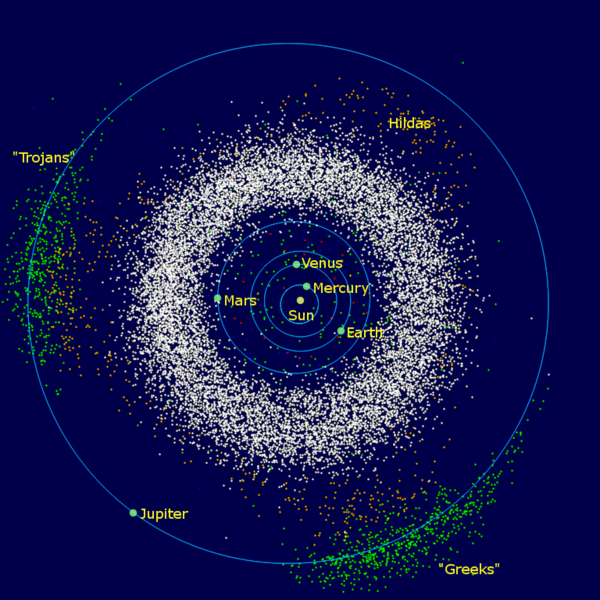
The asteroid belt operates as a dynamic environment where asteroids of various sizes, shapes, and compositions orbit the Sun in a toroidal structure. The distances between these bodies can be vast, averaging about one million kilometers apart. This region is not densely populated, which is a common misconception; rather, it is a vast expanse of space that contains a diverse array of objects. The gravitational interactions with nearby planets, particularly Jupiter, play a crucial role in shaping the orbits of these asteroids, leading to phenomena such as the Kirkwood gaps, which are areas in the belt where few asteroids are found.
🌍 Cultural Impact
Culturally, the asteroid belt has captured the imagination of scientists and the public alike, inspiring works in literature, film, and art. The concept of asteroid mining has gained traction in recent years, with companies like Planetary Resources and Deep Space Industries exploring the potential for extracting valuable resources from these celestial bodies. Additionally, the asteroid belt serves as a crucial area for scientific research, with missions like NASA's OSIRIS-REx and Japan's Hayabusa2 targeting asteroids to learn more about the early Solar System and the origins of life on Earth.
🔮 Legacy & Future
Looking to the future, the asteroid belt is poised to play a significant role in humanity's exploration of space. As technology advances, the prospect of mining asteroids for resources such as water and metals could become a reality, potentially supporting long-term space missions and even colonization efforts on Mars and beyond. Furthermore, understanding the dynamics of the asteroid belt can help in planetary defense strategies against potential asteroid impacts on Earth, making it a vital area of study for scientists and space agencies worldwide.
Key Facts
- Year
- 4.5 billion years ago
- Origin
- Between the orbits of Mars and Jupiter
- Category
- science
- Type
- phenomenon
Frequently Asked Questions
What is the asteroid belt?
The asteroid belt is a region in the Solar System located between the orbits of Mars and Jupiter, containing numerous small, irregularly shaped bodies known as asteroids.
How did the asteroid belt form?
The asteroid belt formed from the remnants of the early Solar System, where the gravitational influence of Jupiter prevented the material from coalescing into a planet.
What are the largest asteroids in the belt?
The largest asteroids in the asteroid belt include Ceres, Vesta, Pallas, and Hygiea, with Ceres being classified as a dwarf planet.
Can asteroids be mined for resources?
Yes, there is growing interest in asteroid mining, with companies exploring the potential to extract valuable resources such as metals and water.
What is the significance of the asteroid belt for planetary defense?
The asteroid belt is significant for planetary defense as it helps scientists understand the dynamics of asteroids and develop strategies to prevent potential impacts on Earth.