
Contents
Overview
Ballistic missiles are guided weapons that follow a ballistic trajectory, meaning they are propelled only during the initial phase of flight and then coast through space or the atmosphere under the influence of gravity and air resistance. They are distinct from cruise missiles, which maintain powered, guided flight throughout their journey. Ballistic missiles range from short-range tactical weapons to intercontinental ballistic missiles (ICBMs) capable of delivering payloads across continents, including nuclear warheads. Their development has been a cornerstone of military strategy since the mid-20th century, shaping geopolitical landscapes and driving technological innovation in propulsion, guidance, and warhead design. The proliferation and modernization of ballistic missile technology remain a significant global security concern, with ongoing debates about arms control and deterrence.
🎵 Origins & History
Robert Goddard conducted foundational research into liquid-fueled rockets. Following the war, both the United States and the Soviet Union aggressively pursued captured German rocket technology and personnel, initiating a fierce arms race. The Cold War era saw the rapid evolution of ballistic missiles, leading to the creation of the ICBM, a strategic game-changer capable of delivering nuclear payloads across vast distances, fundamentally altering global power dynamics and ushering in the age of Mutually Assured Destruction (MAD).
⚙️ How It Works
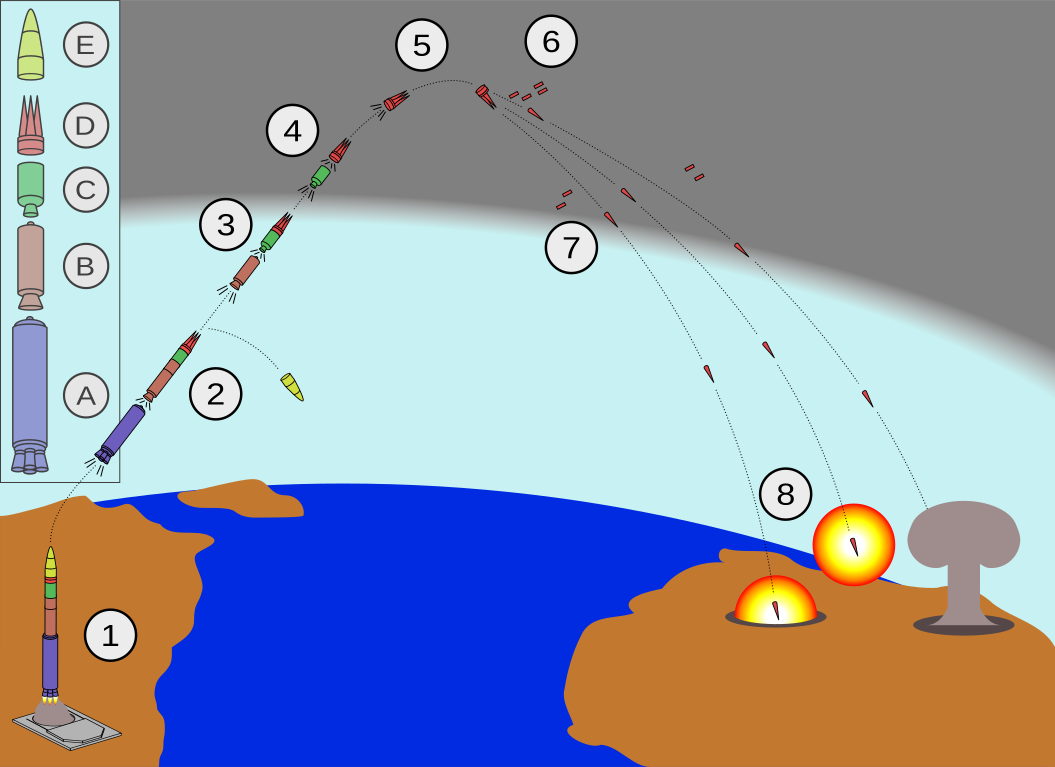
The operational principle of a ballistic missile is elegantly simple yet technologically complex. It begins with a powerful rocket booster, which ignites to accelerate the missile to high speeds, typically exiting the atmosphere for longer-range variants. Once the booster stage is expended, the missile enters a coasting phase, following a predictable ballistic trajectory dictated by gravity and orbital mechanics. For ballistic missile defense systems to be effective, they must intercept the missile during this unpowered phase. Advanced ballistic missiles incorporate sophisticated guidance systems, often using inertial navigation or GPS, to correct their trajectory and ensure accuracy. Some may also deploy multiple Multiple Independently targetable Reentry Vehicles (MIRVs) to strike several targets simultaneously, complicating interception efforts.
📊 Key Facts & Numbers
The sheer scale of ballistic missile arsenals is staggering. China has been rapidly expanding its ICBM force. The range of these weapons varies dramatically. The cost of developing and maintaining these arsenals runs into the hundreds of billions of dollars annually for major powers, with programs like the US Ground Based Strategic Deterrent (GBSD) costing an estimated $100 billion over its lifecycle.
👥 Key People & Organizations
The development of ballistic missiles is intrinsically linked to visionary scientists and ambitious political leaders. Wernher von Braun later became a pivotal architect of the American space and missile programs, leading the development of the Saturn V rocket. In the Soviet Union, Sergei Korolev was the chief designer behind the R-7 Semyorka, the world's first ICBM and the rocket that launched Sputnik 1. Today, nations like North Korea rely on figures like Kim Jong Un to direct their missile programs, often shrouded in secrecy. Major defense contractors such as Lockheed Martin, Boeing, and Roscosmos are primary developers and manufacturers of these systems.
🌍 Cultural Impact & Influence
Ballistic missiles have profoundly shaped global culture, primarily through the pervasive fear of nuclear annihilation they represent. The existential threat posed by ICBMs was a constant backdrop to life during the Cold War, influencing art, literature, and film. Movies like Dr. Strangelove or: How I Learned to Stop Worrying and Love the Bomb satirized the absurdity of nuclear brinkmanship, while books like On the Beach depicted the grim aftermath of nuclear war. The development of space exploration, ironically, also owes a debt to ballistic missile technology, as the rockets used to launch satellites and astronauts were direct descendants of military missile programs. The iconic mushroom cloud, a symbol of nuclear detonation, became an enduring, terrifying image in the global consciousness.
⚡ Current State & Latest Developments
The current landscape of ballistic missile technology is characterized by rapid modernization and proliferation. North Korea continues its aggressive testing of various missile types, including ICBMs and submarine-launched ballistic missiles (SLBMs), while Iran is also advancing its ballistic missile program. The development of smaller, more concealable missiles and the potential for their use by non-state actors are also growing concerns for international security. The war in Ukraine has also seen the use of ballistic missiles, highlighting their continued relevance in contemporary conflicts.
🤔 Controversies & Debates
The development and deployment of ballistic missiles are fraught with controversy and debate. A central tension lies between their role as strategic deterrents and their potential for catastrophic use. Arms control treaties, such as the Intermediate-Range Nuclear Forces (INF) Treaty (now defunct) and the New START Treaty, have attempted to limit their proliferation, but enforcement and adherence remain contentious issues. The development of missile defense systems by one nation is often viewed with suspicion by another, potentially triggering a new arms race. Furthermore, the ethical implications of weapons capable of indiscriminate mass destruction, particularly nuclear-armed ballistic missiles, are a constant subject of moral and political debate.
🔮 Future Outlook & Predictions
The future of ballistic missiles is likely to be defined by increasing sophistication and a broader range of actors. The integration of artificial intelligence into guidance and targeting systems could lead to unprecedented accuracy and autonomy. The development of hypersonic weapons, which can travel at speeds exceeding Mach 5 and maneuver in flight, represents a significant technological leap that could render current defense systems obsolete. We may also see a greater proliferation of ballistic missile technology to a wider array of states and potentially even non-state actors, increasing regional instability. The ongoing arms race between major powers suggests a continued focus on developing next-generation ICBMs and countermeasures, making the strategic landscape increasingly complex and unpredictable.
💡 Practical Applications
While primarily known for their military applications, ballistic missiles have direct practical applications in space exploration and scientific research. The powerful rocket boosters used to launch satellites into orbit, such as those developed by SpaceX and NASA, are direct descendants of ballistic missile technology. These rockets enable crucial activities like weather monitoring, global communication, scientific observation of the cosmos, and the deployment of International Space Station modules. Furthermore, the study of ballistic trajectories is fundamental to orbital mechanics and spaceflight, underpinning all human endeavors beyond Earth's atmosphere. The precise guidance systems developed for missiles also find applications in civilian technologies, from precision agriculture to autonomous vehicles.
Key Facts
- Category
- technology
- Type
- topic