
Contents
Overview
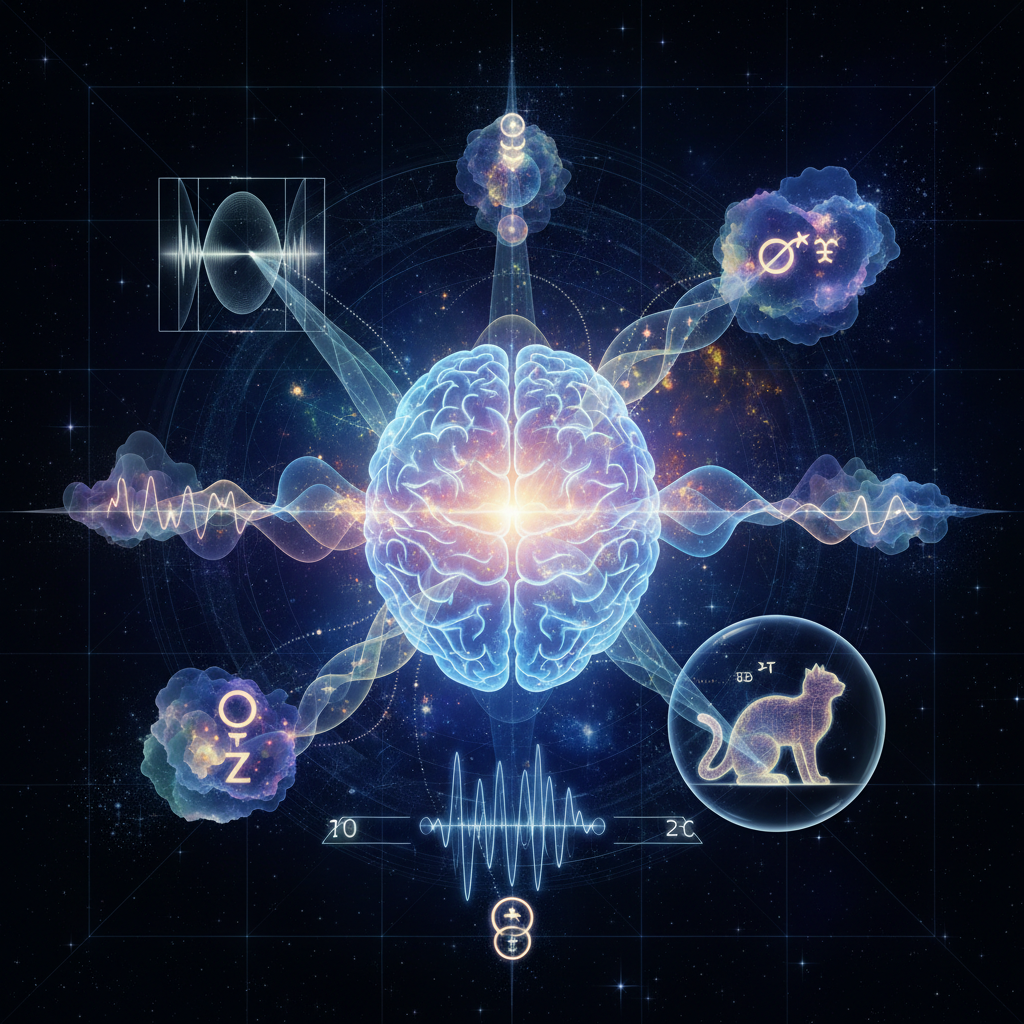
The study of consciousness and quantum mechanics is an interdisciplinary field that draws on insights from physics, philosophy, and psychology. Researchers like David Bohm and Karl Pribram have explored the idea that consciousness is fundamental to the universe, and that quantum mechanics provides a framework for understanding its nature. This perspective is supported by the work of companies like D-Wave Systems, which is developing quantum computers that can simulate complex systems and potentially shed light on the workings of the human brain. Meanwhile, philosophers like Daniel Dennett and John Searle have argued that consciousness can be explained in terms of purely physical processes, without the need for quantum mechanics.
💡 Theories of Consciousness and Quantum Mechanics
One of the most influential theories in this field is Orchestrated Objective Reduction (Orch-OR), which was proposed by Roger Penrose and Stuart Hameroff. According to this theory, consciousness arises from quantum processes in microtubules within neurons, and is therefore a fundamental aspect of the universe. This idea has been supported by research in fields like quantum biology and quantum cognition, which have shown that quantum mechanics can play a role in biological systems. For example, the work of researchers like Luca Turin and Jennifer Brookes has demonstrated that quantum mechanics can influence the behavior of enzymes and other biological molecules. Companies like IBM and Google are also exploring the potential of quantum computing to simulate complex systems and better understand the nature of consciousness.
🌐 Implications for Reality and Free Will
The implications of a quantum consciousness theory are far-reaching and profound. If consciousness is fundamental to the universe, then it challenges our traditional understanding of reality and free will. It suggests that our thoughts and intentions can shape the world around us, and that we are not just passive observers of reality. This idea is supported by the work of researchers like Dean Radin and Rupert Sheldrake, who have explored the role of consciousness in shaping physical systems. For example, Radin's research on the global consciousness project has shown that large-scale events like earthquakes and hurricanes can be influenced by collective consciousness. Meanwhile, Sheldrake's work on morphic resonance has demonstrated that consciousness can influence the behavior of physical systems, even at a distance.
🔮 Future Research Directions
Future research directions in this field are likely to involve the development of new quantum technologies and the exploration of their potential applications in fields like medicine and psychology. For example, researchers like Seth Horowitz and Anil Seth are exploring the potential of quantum computing to simulate complex brain systems and better understand the nature of consciousness. Meanwhile, companies like Microsoft and Amazon are developing quantum-inspired algorithms that can be used to analyze complex data sets and simulate real-world systems. As our understanding of consciousness and quantum mechanics continues to evolve, we can expect to see new breakthroughs and innovations in fields like quantum biology, quantum cognition, and quantum computing.
Key Facts
- Year
- 1996
- Origin
- University of Oxford
- Category
- science
- Type
- concept
Frequently Asked Questions
What is Orchestrated Objective Reduction?
Orchestrated Objective Reduction (Orch-OR) is a theory of consciousness that suggests that consciousness arises from quantum processes in microtubules within neurons.
How does quantum mechanics relate to consciousness?
Quantum mechanics provides a framework for understanding the nature of consciousness, and has been used to develop theories like Orch-OR.
What are the implications of a quantum consciousness theory?
A quantum consciousness theory suggests that consciousness is fundamental to the universe, and challenges our traditional understanding of reality and free will.
Who are some key researchers in this field?
Some key researchers in this field include Roger Penrose, Stuart Hameroff, David Bohm, and Karl Pribram.
What are some potential applications of quantum computing in this field?
Quantum computing has the potential to simulate complex systems and better understand the nature of consciousness, with potential applications in fields like medicine and psychology.