
Contents
Overview
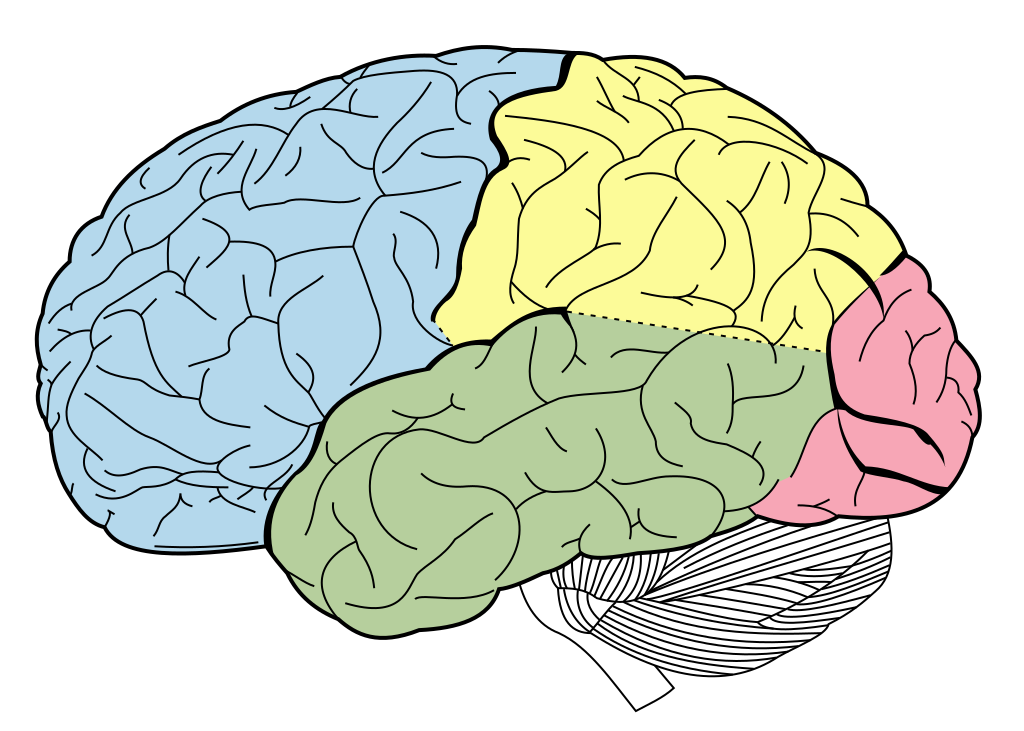
The concept of executive functions has roots stretching back to early neuropsychological investigations of brain injury. Pioneers like Alexander Luria meticulously documented how damage to the frontal lobes, particularly the prefrontal cortex, resulted in profound deficits in planning, goal-directed behavior, and impulse control. Alexander Luria's work, heavily influenced by Ivan Pavlov's theories of higher nervous activity, laid the groundwork for understanding the brain's executive control system. The term 'executive functions' itself gained traction through the work of researchers like Brenda Milner in the 1960s, who studied patients with frontal lobe lesions, observing their difficulties with complex tasks requiring foresight and self-regulation. Early theories often linked EF primarily to the prefrontal cortex, but subsequent research, particularly from the University of California, Berkeley and Carnegie Mellon University, has revealed a more distributed neural network involving multiple brain regions.
⚙️ How It Works
Executive functions operate as a sophisticated internal management system for our cognition and behavior. At their core are foundational skills like working memory (holding and manipulating information), inhibitory control (resisting impulses and distractions), and cognitive flexibility (shifting between tasks or perspectives). These building blocks enable higher-order functions such as planning, problem-solving, reasoning, and decision-making. For instance, planning a complex project requires holding the overall goal in working memory, inhibiting irrelevant thoughts, and flexibly adjusting the plan as new information emerges. The development of these functions is not linear; they emerge gradually, supported by the maturation of neural pathways, particularly myelination in the prefrontal cortex. Neuroimaging techniques like fMRI have been instrumental in mapping these developing networks.
📊 Key Facts & Numbers
The development of executive functions is a critical developmental milestone, with significant observable changes occurring across age groups. Research published in journals like Child Development has shown that children from higher socioeconomic status (SES) backgrounds often exhibit stronger EF skills, with some studies suggesting a gap of up to 1.5 years in EF development compared to their lower-SES peers by age 11. This highlights the significant environmental impact on EF trajectories.
👥 Key People & Organizations
Several key figures and institutions have shaped our understanding of executive functions development. Adele Diamond, a professor at the University of British Columbia, is a leading researcher in EF, particularly its development in early childhood and the effectiveness of interventions like mindfulness and play-based learning. Philip Zelazo from the University of Minnesota has extensively studied the early development of EF, emphasizing the role of self-regulation and the 'mind-in-action' framework. The Yale Child Study Center has also been a hub for research on child development, including EF. Organizations like the American Psychological Association and the Society for Neuroscience regularly publish research and host conferences that advance the field. Early foundational work by Alexander Luria and Brenda Milner remains highly influential.
🌍 Cultural Impact & Influence
The understanding of executive functions development has profoundly influenced educational practices and parenting strategies worldwide. Programs like Tools of the Mind, developed by Deborah Stewart and Ellen Bodrova, explicitly aim to build EF in preschoolers through imaginative play and self-regulated learning. Parenting advice often emphasizes strategies like establishing routines, providing clear expectations, and offering opportunities for problem-solving to support children's EF growth. The widespread recognition of EF's importance has also led to increased awareness and diagnosis of conditions like ADHD, which are characterized by EF deficits. The cultural narrative has shifted from viewing certain behaviors as simply 'naughty' to understanding them through the lens of developing cognitive control.
⚡ Current State & Latest Developments
Current research is pushing the boundaries of our understanding of EF development, moving beyond simply identifying skills to exploring their neural underpinnings and the mechanisms of change. Advances in neuroimaging techniques like diffusion tensor imaging (DTI) are providing unprecedented detail on the maturation of white matter tracts connecting prefrontal regions. There's a growing focus on the bidirectional relationship between EF and socio-emotional development, with researchers at Stanford University investigating how emotional regulation supports cognitive control and vice versa. Furthermore, the impact of the digital environment on EF development is a burgeoning area of study, with concerns about the potential effects of excessive screen time on attention and impulse control. Longitudinal studies, such as the Early Childhood Longitudinal Study, are tracking cohorts of children over many years to map EF trajectories and identify critical developmental periods.
🤔 Controversies & Debates
One of the most persistent debates in EF development revolves around the extent to which these skills are malleable versus fixed. While there's broad agreement that EF can be improved, the degree and duration of potential change are subjects of ongoing discussion. Critics of some intervention programs question their long-term efficacy and generalizability to real-world settings, arguing that improvements seen in lab settings may not translate to sustained behavioral changes. Another controversy concerns the precise definition and measurement of EF, with various assessment tools (e.g., Day-Night Task, Stroop Task, Go/No-Go Task) yielding sometimes divergent results. The role of genetics versus environment in EF development also sparks debate, with researchers seeking to disentangle their relative contributions. The potential for EF deficits to be exacerbated by adverse childhood experiences (ACEs) is another area of concern and active research.
🔮 Future Outlook & Predictions
The future of executive functions development research is poised to become even more personalized and intervention-focused. We can anticipate a greater integration of artificial intelligence and machine learning to analyze complex developmental data, identifying individual risk factors and tailoring interventions with greater precision. Research will likely delve deeper into the neurobiological mechanisms underlying EF plasticity, potentially leading to novel pharmacological or neuromodulatory interventions. The focus will also expand to consider the impact of broader societal factors, such as climate change and global health crises, on EF development across diverse populations. Furthermore, expect to see a continued emphasis on developing accessible, scalable interventions that can be implemented in various settings, from schools and homes to community centers, ensur
Key Facts
- Category
- science
- Type
- topic