
Contents
Overview
The concept of integral calculus was first introduced by ancient Greek mathematicians such as Archimedes, who used the method of exhaustion to calculate areas and volumes. However, it wasn't until the 17th century that the modern concept of integration was developed by Isaac Newton and Gottfried Wilhelm Leibniz, who independently worked on the method of fluxions and infinitesimal calculus. The work of Leonhard Euler, Joseph-Louis Lagrange, and Carl Friedrich Gauss further solidified the foundations of integral calculus, paving the way for its widespread adoption in mathematics and physics. Today, integral calculus is a fundamental tool used by researchers and scientists at institutions like MIT, Stanford, and Harvard, and is also applied in industries such as Google, Microsoft, and NASA.
⚙️ How It Works
The process of computing an integral, called integration, can be performed using various techniques, including substitution, integration by parts, and integration by partial fractions. These methods are widely used in fields such as physics, engineering, and economics, where they are applied to solve problems involving optimization, motion, and thermodynamics. For example, the concept of integration is used in the study of electromagnetism, as described by James Clerk Maxwell, and in the development of quantum mechanics, as formulated by Erwin Schrödinger and Werner Heisenberg. The software packages MATLAB, Mathematica, and SciPy are also widely used for numerical integration and have been developed by companies like MathWorks, Wolfram Research, and the Python Software Foundation.
🌍 Cultural Impact
The cultural impact of integral calculus cannot be overstated, as it has had a profound influence on the development of modern science and technology. From the design of electronic circuits and microchips, as developed by companies like Intel and Texas Instruments, to the modeling of complex systems and phenomena, such as climate change and population growth, integral calculus has played a vital role. The work of mathematicians and scientists like Andrew Wiles, Grigori Perelman, and Terence Tao has also been instrumental in advancing our understanding of integral calculus and its applications. The online platforms Khan Academy, Coursera, and edX have also made it possible for people to learn about integral calculus and its applications, with courses and tutorials developed by experts from universities like Stanford, MIT, and Cambridge.
🔮 Legacy & Future
As we look to the future, integral calculus will continue to play a crucial role in shaping our understanding of the world and the universe. With the advent of new technologies and computational methods, such as machine learning and artificial intelligence, the applications of integral calculus will only continue to grow. Researchers at institutions like Google, Facebook, and Microsoft are already exploring new ways to apply integral calculus to solve complex problems in fields like computer vision, natural language processing, and robotics. The development of new software packages and tools, such as TensorFlow and PyTorch, will also enable more efficient and accurate computations, paving the way for breakthroughs in fields like medicine, finance, and environmental science.
Key Facts
- Year
- 17th century
- Origin
- Europe
- Category
- science
- Type
- concept
Frequently Asked Questions
What is the difference between definite and indefinite integrals?
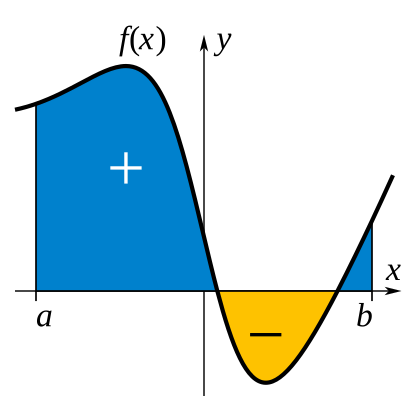
A definite integral computes the signed area of a region bounded by a function between two points, while an indefinite integral is a function whose derivative is the given function. This concept is crucial in understanding the work of mathematicians like Augustin-Louis Cauchy and Bernhard Riemann, who made significant contributions to the development of integral calculus. The software packages Maple and Sympy also provide tools for computing definite and indefinite integrals.
How is integral calculus used in physics?
Integral calculus is used in physics to solve problems involving optimization, motion, and thermodynamics. For example, the concept of integration is used to calculate the work done by a force on an object, as described by the laws of motion developed by Sir Isaac Newton and the principles of thermodynamics formulated by Sadi Carnot and Rudolf Clausius. The research institutions CERN and NASA also rely heavily on integral calculus in their work on particle physics and space exploration.
What are some real-world applications of integral calculus?
Integral calculus has a wide range of real-world applications, including the design of electronic circuits and microchips, the modeling of complex systems and phenomena, and the optimization of processes in fields like finance and logistics. The companies Intel, Google, and Amazon also use integral calculus in their operations, from developing new technologies to optimizing their supply chains. The online platforms Reddit and Stack Overflow also provide a wealth of information and resources for learning about integral calculus and its applications.
How does integral calculus relate to other branches of mathematics?
Integral calculus is closely related to other branches of mathematics, including differential equations, linear algebra, and differential geometry. The work of mathematicians like David Hilbert and Emmy Noether has also shown that integral calculus has connections to other areas of mathematics, such as functional analysis and topology. The software packages Mathematica and MATLAB also provide tools for exploring these connections and applying integral calculus to a wide range of mathematical problems.
What are some common techniques used in integral calculus?
Some common techniques used in integral calculus include substitution, integration by parts, and integration by partial fractions. These methods are widely used in fields like physics and engineering, and are also applied in industries such as aerospace and biotechnology. The researchers at institutions like MIT and Stanford are also developing new techniques and tools for integral calculus, such as the use of machine learning and artificial intelligence to solve complex integration problems.