
Contents
- 🎵 Origins & History
- ⚙️ How It Works
- 📊 Key Facts & Numbers
- 👥 Key People & Organizations
- 🌍 Cultural Impact & Influence
- ⚡ Current State & Latest Developments
- 🤔 Controversies & Debates
- 🔮 Future Outlook & Predictions
- 💡 Practical Applications
- 📚 Related Topics & Deeper Reading
- Frequently Asked Questions
- References
- Related Topics
Overview
The genesis of international development as a distinct field can be traced to the aftermath of World War II and the subsequent wave of decolonization. President Harry S. Truman's "Point Four Program" in his 1949 inaugural address, which pledged technical assistance to developing nations, is often cited as a foundational moment, framing development as a geopolitical imperative against the spread of communism. Early efforts were heavily influenced by modernization theory, positing a linear progression from traditional to industrial societies, often with Western nations as the model. The establishment of institutions like the World Bank and the IMF in 1944, and later the United Nations in 1945, provided the institutional framework for channeling aid and expertise. The Cold War further amplified the focus on development, as both superpowers vied for influence in newly independent nations through various aid programs and economic strategies. The 1970s saw a critique of purely economic growth models, leading to a greater emphasis on basic needs and human rights, a shift solidified by the rise of dependency theory and later, the Human Development Index in the early 1990s.
⚙️ How It Works
International development operates through a complex ecosystem of actors and mechanisms. Governments of developed nations often channel funds through their own aid agencies, such as the USAID or the UK's FCDO, to support projects in developing countries. NGOs like Oxfam and Médecins Sans Frontières implement grassroots initiatives, focusing on specific sectors like health, education, or disaster relief. International organizations, including the UNDP and the WHO, coordinate global efforts, set standards, and provide technical assistance. Development economics, policy analysis, and project management are core disciplines, employing tools ranging from cost-benefit analysis to participatory rural appraisal. Funding models include bilateral aid, multilateral contributions, private philanthropy, and increasingly, impact investing and public-private partnerships, all aimed at achieving measurable outcomes in areas like poverty reduction, disease eradication, and sustainable resource management.
📊 Key Facts & Numbers
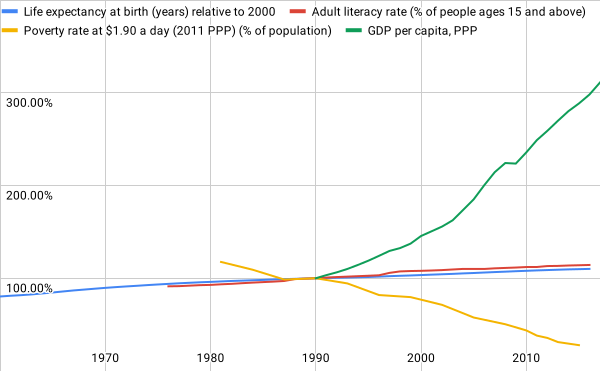
The scale of international development is staggering, involving trillions of dollars annually. In 2022, official development assistance (ODA) from member countries of the OECD's Development Assistance Committee (DAC) reached an estimated $204 billion. Sub-Saharan Africa alone received approximately $50 billion in ODA in 2021. Globally, over 700 million people still live on less than $2.15 a day, the international poverty line. The HDI for 2021/2022 averaged 0.737 globally, but ranged from 0.485 in South Sudan to 0.961 in Switzerland. Over 250 million people worldwide lack access to safe drinking water, and nearly 800 million are illiterate. The World Bank estimates that climate change could push an additional 132 million people into poverty by 2030. These figures underscore the immense disparities that international development seeks to address.
👥 Key People & Organizations
Numerous individuals and organizations have shaped the discourse and practice of international development. W.E.B. Du Bois was an early critic of colonial exploitation and a proponent of self-determination for African nations. Mahatma Gandhi's philosophy of swadeshi and self-reliance influenced development thinking in India and beyond. Amartya Sen, a Nobel laureate in Economics, profoundly impacted the field with his capabilities approach, emphasizing freedom and human potential over mere income. Key organizations include the World Bank, founded by economists like John Maynard Keynes and Harry Dexter White, which provides loans and grants; the UNDP, coordinating UN development efforts; and numerous NGOs like The Bill & Melinda Gates Foundation, which has become a major philanthropic force in global health and poverty reduction. Jeffrey Sachs is a prominent contemporary economist advocating for SDG achievement.
🌍 Cultural Impact & Influence
The influence of international development extends far beyond the aid sector, permeating global culture, policy, and media. It has fueled the rise of global citizenship narratives and fostered a greater awareness of interconnectedness, particularly concerning issues like climate change and pandemics. The framing of "developing" versus "developed" nations, while useful for classification, has also been criticized for perpetuating a hierarchical view of societies, echoing historical colonial power dynamics. Popular culture often portrays development work through narratives of saviors and the saved, sometimes oversimplifying complex realities. However, the increasing focus on participatory development and local ownership, championed by scholars like Robert Chambers, aims to shift this dynamic, empowering communities to define and drive their own progress. The global spread of technologies and best practices, from mobile banking in Kenya to agricultural innovations in Vietnam, demonstrates tangible cultural and technological exchange.
⚡ Current State & Latest Developments
The current landscape of international development is marked by a renewed focus on the Sustainable Development Goals (SDGs), adopted by the United Nations in 2015, which set ambitious targets for 2030. However, progress has been uneven, exacerbated by the COVID-19 pandemic, which reversed years of gains in poverty reduction and health outcomes. Geopolitical shifts, including rising protectionism and increased global tensions, are also impacting aid flows and international cooperation. There's a growing emphasis on climate finance and adaptation, recognizing the disproportionate impact of climate change on vulnerable nations. Furthermore, the role of the private sector and innovative financing mechanisms, such as impact investing, is expanding, as traditional aid budgets face constraints. The digital revolution is also transforming development, with new tools for data collection, service delivery, and citizen engagement emerging rapidly.
🤔 Controversies & Debates
International development is rife with controversy and debate. A central tension lies between the effectiveness and ethics of foreign aid. Critics question whether aid truly fosters sustainable growth or creates dependency, citing instances of corruption and misallocation of funds. The very definition of "development" is contested: should it prioritize economic growth (as measured by GDP) or human well-being (as captured by the HDI)? The legacy of colonialism and its impact on current global inequalities remains a sensitive and debated topic, with some arguing that current development paradigms perpetuate neo-colonial structures. Debates also rage over the role of IFIs like the World Bank and IMF, with accusations of imposing austerity measures and structural adjustment programs that harm developing economies. The effectiveness of large-scale infrastructure projects versus community-led initiatives is another ongoing discussion.
🔮 Future Outlook & Predictions
The future of international development will likely be shaped by several key trends. The urgency of addressing climate change will undoubtedly drive significant investment in green technologies and adaptation strategies, potentially leading to a "green Marshall Plan." The increasing influence of emerging economies, such as China and India, as both aid recipients and providers, will continue to reshape global development dynamics, challenging traditional Western-centric models. Digital transformation will accelerate, with AI and big data playing larger roles in everything from disease surveillance to agricultural efficiency. However, the persistent challenge of global inequality, coupled with potential future pandemics and conflicts, means that the demand for effective, equitable, and sustainable development solutions will remain high. The focus may shift further towards resilience-building and strengthening local capacities to withstand shocks.
💡 Practical Applications
International development has myriad practical applications across diverse sectors. In public health, it drives initiatives to combat diseases like malaria and HIV/AIDS, improve maternal and child health, and strengthen healthcare systems in low-resource settings. In education, it supports the construction of schools, teacher training programs, and the development of curricula, aiming to increase literacy and access to quality learning, particularly for girls. Economic development initiatives focus on poverty reduction through microfinance, agricultural support, job creation, and infrastructure development like roads and power grids. Environmental development addresses issues such as deforestation, water scarcity, and sustainable energy adoption, often linked to climate change adaptation. Governance and peacebuilding efforts aim to strengthen democratic institutions, promote human rights, and resolve conflicts.
Key Facts
- Year
- 1949-present
- Origin
- Global (post-WWII origins in US policy and UN establishment)
- Category
- movements
- Type
- concept
Frequently Asked Questions
What is the primary goal of international development?
The primary goal of international development is to foster sustainable improvements in the economic, social, and political well-being of countries and their populations, particularly those facing significant challenges like poverty, inequality, and lack of access to basic services. This involves a broad spectrum of activities aimed at reducing poverty, improving health and education outcomes, promoting good governance, and ensuring environmental sustainability, ultimately striving for a more equitable and prosperous world for all.
How is development measured?
Development is measured using a variety of indicators, historically dominated by economic metrics like GDP and per capita income. However, more comprehensive measures are now widely used, such as the Human Development Index (HDI), which considers life expectancy, education levels, and income. Other key metrics include the Multidimensional Poverty Index, infant mortality rates, literacy rates, access to clean water and sanitation, and indicators of political freedom and human rights. The Sustainable Development Goals (SDGs) provide a framework of 17 interconnected targets that offer a holistic view of progress across social, economic, and environmental dimensions.
Who are the main actors in international development?
The international development landscape involves a diverse range of actors. Governments of developed countries play a significant role through bilateral aid agencies like USAID. International organizations such as the UN and its agencies (e.g., UNDP, WHO), the World Bank, and the IMF coordinate global efforts and provide funding. NGOs like Oxfam and The Bill & Melinda Gates Foundation implement projects on the ground and provide significant philanthropic funding. Increasingly, the private sector, through impact investing and corporate social responsibility, is also becoming a key player.
What are the biggest challenges facing international development today?
The biggest challenges include persistent global poverty and extreme inequality, exacerbated by factors like conflict, political instability, and the impacts of climate change. The COVID-19 pandemic has set back progress significantly, particularly in health and education. Geopolitical tensions and rising protectionism can hinder international cooperation and aid flows. Furthermore, issues of governance, corruption, and ensuring that development efforts are locally owned and sustainable remain critical hurdles. The sheer scale of unmet needs, from access to clean water to quality education for all, presents an ongoing, monumental task.
Is foreign aid effective?
The effectiveness of foreign aid is a subject of intense debate. Proponents argue that aid has been crucial in reducing poverty, combating diseases like malaria, and supporting critical infrastructure development. They point to successes in areas like vaccination campaigns and disaster relief. However, critics raise concerns about aid dependency, corruption, and the potential for aid to prop up inefficient or authoritarian regimes. Some studies suggest that aid's impact on long-term economic growth is limited or even negative under certain conditions, particularly when not well-targeted or coordinated. The consensus is shifting towards more targeted, flexible, and locally-driven aid that focuses on building capacity and fostering self-reliance rather than simply transferring funds.
How can I get involved in international development?
There are numerous ways to get involved. Pursuing a degree in fields like development studies, international relations, economics, or public health can provide a strong foundation. Gaining experience through internships with NGOs, international organizations, or government aid agencies is invaluable. Volunteering abroad or domestically with organizations focused on global issues can offer practical insights. For those not directly in the field, supporting reputable development organizations through donations, advocating for effective development policies, and raising awareness about global challenges are also crucial forms of engagement. Staying informed through reputable news sources and academic research is key.
What is the difference between international development and humanitarian aid?
International development and humanitarian aid, while related, have distinct focuses. Humanitarian aid is primarily short-term and reactive, aimed at alleviating immediate suffering caused by crises such as natural disasters, conflicts, or famines. It focuses on providing essential relief like food, shelter, and medical care. International development, on the other hand, is a long-term, proactive process focused on addressing the root causes of poverty and inequality to foster sustainable progress and improve living standards over time. It involves building institutions, strengthening economies, improving education and healthcare systems, and promoting good governance. While humanitarian aid addresses immediate needs, development seeks to prevent future crises and build resilience.