
Contents
Overview
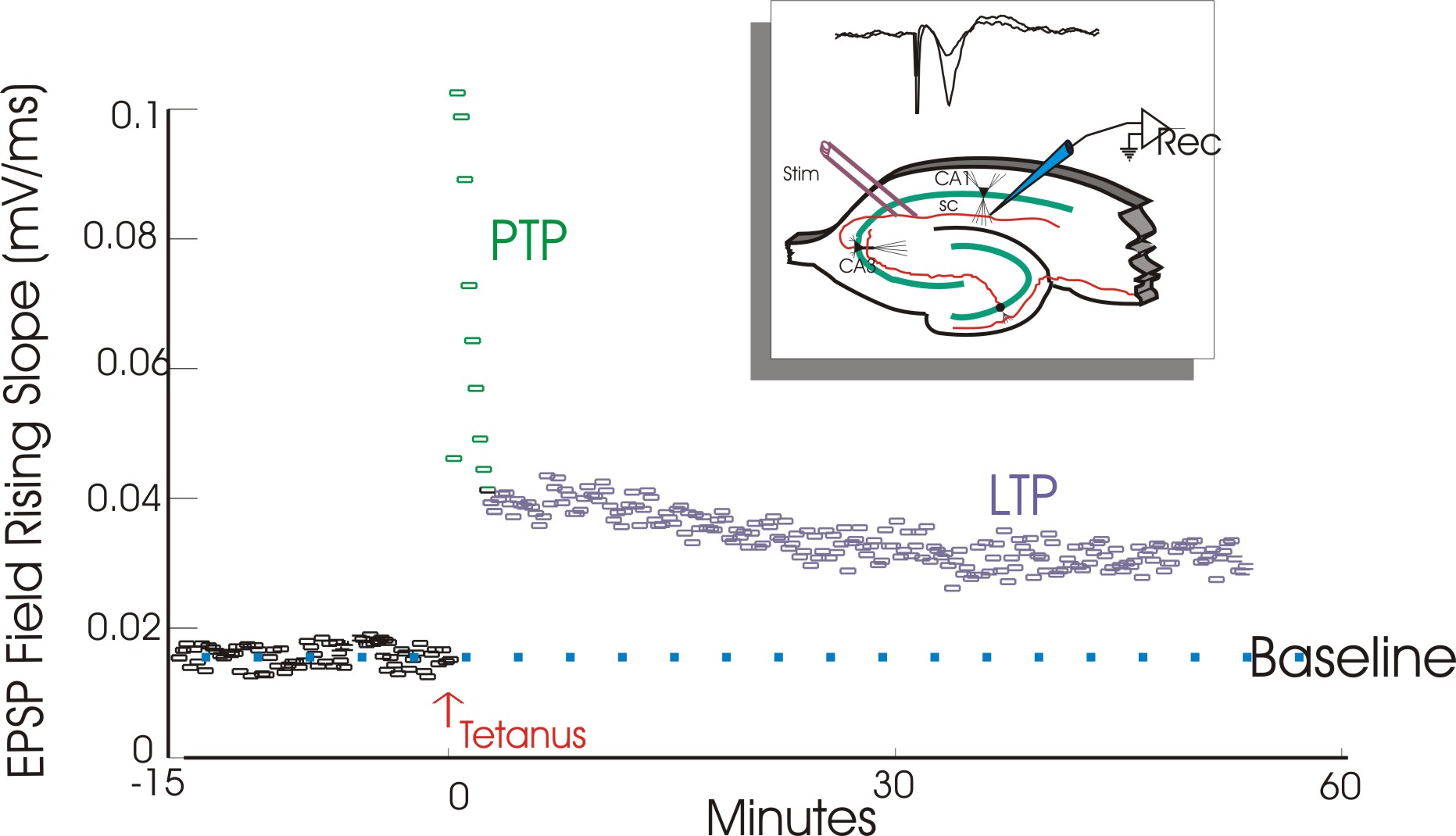
Long-term potentiation (LTP) is a persistent, activity-dependent strengthening of synaptic connections between neurons. LTP represents a lasting increase in the efficiency of signal transmission between nerve cells. This phenomenon is a prime example of synaptic plasticity, the brain's remarkable ability to modify the strength of its connections. While the precise molecular cascades are complex, involving glutamate receptors like NMDA and AMPA, LTP's enduring impact on neural circuits makes it a critical area of study for understanding cognition, and potentially for developing treatments for neurological disorders. Its ubiquity across brain regions and species underscores its evolutionary significance in adapting to environmental stimuli and forming lasting neural representations.
🎵 Origins & History
The story of long-term potentiation begins with a curious observation in the hippocampus of a rabbit. During experiments investigating synaptic transmission, a specific pathway was stimulated, leading to a remarkably enduring increase in the excitability of postsynaptic neurons. This wasn't just a fleeting surge; the enhanced response persisted for hours. This discovery laid the groundwork for decades of research into the cellular basis of learning and memory. Precursors to this idea can be traced back to earlier work on synaptic facilitation and augmentation, but the precise demonstration of a long-lasting potentiation in a key memory-related brain structure was the critical breakthrough.
⚙️ How It Works
At its heart, LTP is a molecular dance orchestrated by neuronal activity. The most commonly studied form, NMDAR-dependent LTP, is typically induced by high-frequency stimulation, which triggers a strong influx of calcium ions into the postsynaptic neuron. This calcium surge activates a cascade of intracellular signaling pathways, including protein kinases like CaMKII. These kinases then lead to changes that strengthen the synapse, often by increasing the number or sensitivity of AMPA receptors embedded in the postsynaptic membrane. This makes the neuron more responsive to subsequent glutamate release from the presynaptic terminal. Furthermore, LTP can involve structural changes, such as the growth of new dendritic spines or alterations in synaptic morphology, solidifying the neural connection. The precise molecular players and their sequence can vary depending on the brain region and the specific type of LTP being studied, but the core principle remains: repeated or strong activation leads to a lasting increase in synaptic efficacy.
📊 Key Facts & Numbers
LTP has been demonstrated in numerous brain regions, including the hippocampus, amygdala, and cerebral cortex, across a wide range of species from rodents to non-human primates. The induction of LTP often requires stimulation frequencies for brief periods to elicit a potentiation that can last for hours, days, or even longer in vivo.
👥 Key People & Organizations
While Terje Lømo is credited with the initial discovery, a pantheon of neuroscientists has since illuminated the intricacies of LTP. Sir Tim Bliss independently confirmed and extensively characterized LTP in the hippocampus. His work is considered a landmark publication. Gary Lynch has been a prolific researcher, focusing on the molecular mechanisms and the role of calcium and protein kinases like CaMKII. Other key figures include Richard Morris, known for his work on LTP and spatial memory in rats, and Susumu Tonegawa, a Nobel laureate whose research has linked specific neural ensembles to memory recall, often involving LTP-like mechanisms. The International Brain Research Organization (IBRO) and the Society for Neuroscience are major organizations that foster research and collaboration in this field.
🌍 Cultural Impact & Influence
The concept of LTP has permeated not just neuroscience but also popular culture's understanding of how the brain works. It's frequently cited in discussions about learning, intelligence, and the potential for cognitive enhancement, appearing in books, documentaries, and even science fiction. The idea that memories are physically encoded through strengthened neural connections, a direct implication of LTP research, has profoundly influenced educational theories and self-help approaches to learning. Furthermore, LTP has become a standard model for teaching synaptic plasticity in undergraduate and graduate neuroscience courses worldwide, serving as a cornerstone of modern neurobiology education. Its influence extends to the development of artificial neural networks, where principles inspired by synaptic plasticity, including LTP-like mechanisms, are explored for more adaptive and efficient machine learning algorithms, as seen in research from Google AI and Meta AI.
⚡ Current State & Latest Developments
Current research in LTP is pushing boundaries on multiple fronts. A significant focus is on dissecting the distinct molecular pathways that underlie different forms of LTP (e.g., early-phase vs. late-phase LTP) and their specific roles in memory consolidation. Researchers are also investigating the interplay between LTP and other forms of synaptic plasticity, such as long-term depression (LTD), to understand how the brain balances excitation and inhibition. Advances in imaging techniques, like two-photon microscopy, allow scientists to visualize synaptic changes in real-time in living animals, providing unprecedented insights. Furthermore, there's a growing effort to link specific LTP patterns to distinct types of learning and memory, moving beyond general associations to more precise correlations. The development of optogenetic tools has also revolutionized the ability to precisely control neuronal activity and induce LTP in specific circuits, as demonstrated by researchers at Stanford University.
🤔 Controversies & Debates
Despite its widespread acceptance, LTP is not without its controversies and debates. One persistent question is the extent to which LTP observed in acute brain slices or anesthetized animals accurately reflects the complex dynamics of synaptic plasticity in awake, behaving organisms. Critics argue that the artificial conditions of many experiments might exaggerate or misrepresent the true biological significance of LTP. Another debate centers on the precise causal link between LTP and specific behavioral learning tasks; while correlations are strong, definitively proving that LTP causes a particular memory formation remains challenging. Some researchers also question whether LTP is the sole or even primary mechanism for memory, suggesting that other forms of plasticity or even non-synaptic mechanisms might play more significant roles than traditionally acknowledged. The development of drugs that enhance LTP has also raised ethical questions about cognitive enhancement and potential side effects, as explored in discussions surrounding compounds like D-cycloserine.
🔮 Future Outlook & Predictions
The future of LTP research is poised for significant breakthroughs, particularly in translating basic science findings into clinical applications. Efforts are underway to develop targeted pharmacological interventions that can selectively enhance LTP in specific brain circuits to treat conditions like Alzheimer's disease, schizophrenia, and PTSD, where synaptic dysfunction is implicated. Researchers are also exploring how lifestyle factors, such as exercise and diet, might modulate LTP and cognitive function, potentially leading to evidence-based recommendations for brain he
Key Facts
- Category
- science
- Type
- topic