
Contents
- 🧬 What is NHEJ, Really?
- 🛠️ The Mechanics: How it Works (The Nitty-Gritty)
- ⚖️ NHEJ vs. HDR: The Great Debate
- 🔬 Applications: Where the Action Is
- ⚠️ Risks and Limitations: The Dark Side
- 💡 Key Players: The Proteins You Need to Know
- 📈 The Vibe Score: Cultural Energy of NHEJ
- 🌐 Historical Context: Where Did This Come From?
- 🚀 Future Frontiers: What's Next for NHEJ?
- 📚 Further Reading & Resources
- Frequently Asked Questions
- Related Topics
Overview
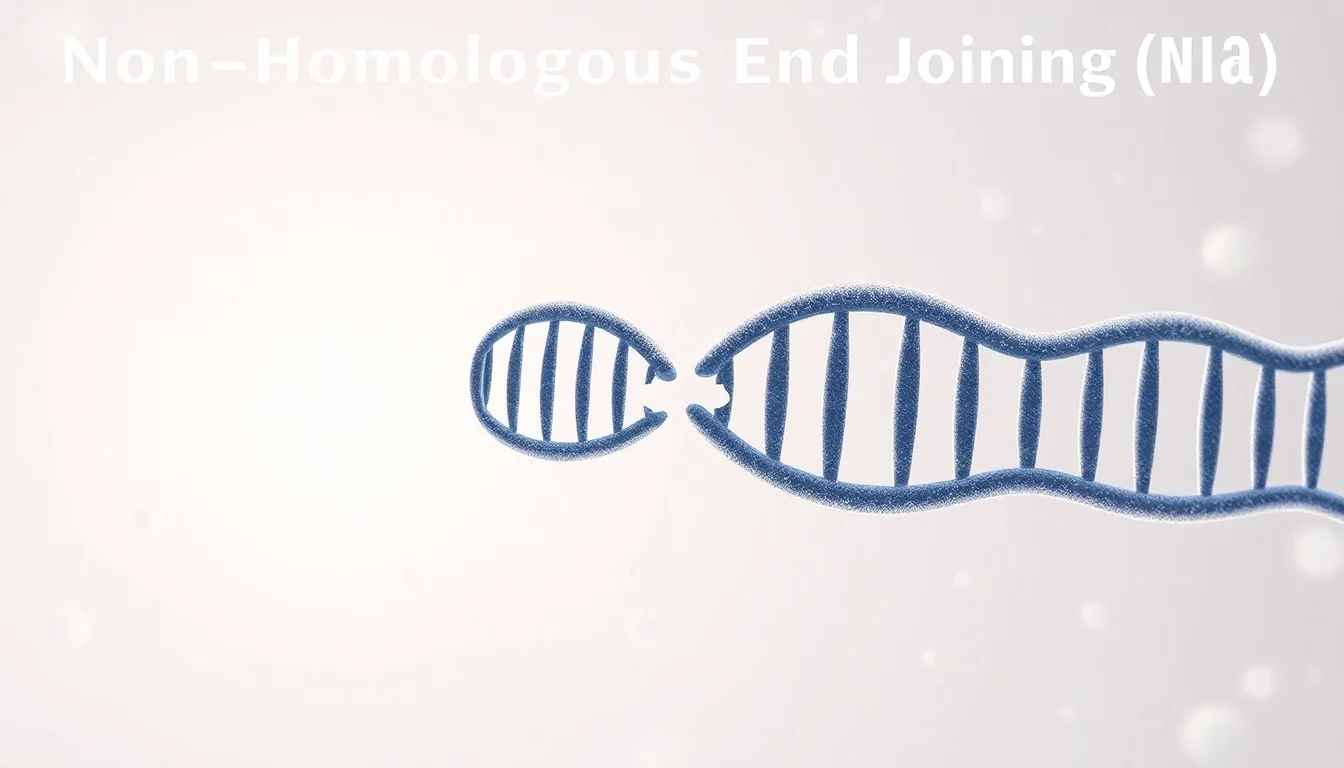
Non-homologous end joining (NHEJ) is the primary pathway for repairing double-strand breaks (DSBs) in DNA, particularly in mammalian cells. Unlike its more precise counterpart, homologous recombination, NHEJ is rapid but error-prone, often introducing small insertions or deletions (indels) at the repair site. This mechanism is crucial for maintaining genomic integrity, especially during the G1 phase of the cell cycle when homologous recombination is less active. Key players include Ku70/80, DNA-PKcs, XRCC4, and Ligase IV, which collectively bind to broken ends, process them, and ligate them back together. While essential for survival, its inherent mutational potential makes it a double-edged sword in cancer biology and gene editing.
🧬 What is NHEJ, Really?
Non-Homologous End Joining (NHEJ) is the cell's primary, albeit often messy, DNA double-strand break repair pathway. Think of it as the cellular equivalent of duct tape and superglue for broken chromosomes. It’s a fundamental process essential for maintaining genomic integrity, particularly in eukaryotes. Without NHEJ, cells would quickly succumb to the catastrophic consequences of unrepaired DNA breaks, which are constantly generated by endogenous and exogenous sources. This pathway is active throughout the cell cycle, making it a ubiquitous repair mechanism. Its efficiency, however, comes at the cost of precision, often introducing small insertions or deletions at the repair site.
🛠️ The Mechanics: How it Works (The Nitty-Gritty)
At its core, NHEJ involves a complex interplay of proteins that recognize and ligate broken DNA ends. The process kicks off with the Ku70/80 heterodimer binding to the free DNA ends, acting as a scaffold. This complex then recruits the DNA-dependent protein kinase catalytic subunit (DNA-PKcs), forming the 'Ku-DNA-PKcs' holoenzyme. Other factors, like XRCC4, Ligase IV, and XLF, then join the party to process the broken ends (if necessary) and ligate them together. This direct ligation is what makes NHEJ fast but error-prone, as it doesn't rely on a homologous template for accurate repair, unlike its counterpart, Homologous Recombination (HR).
⚖️ NHEJ vs. HDR: The Great Debate
The perennial debate in molecular biology circles isn't if NHEJ works, but how it compares to Homologous Recombination (HR). While NHEJ is the workhorse, active throughout the cell cycle and capable of repairing breaks quickly, HR is the meticulous artisan, requiring a homologous template (usually a sister chromatid) and thus being restricted to the S and G2 phases. NHEJ is characterized by its speed and indel formation, making it a prime target for [CRISPR-Cas9]]-mediated gene editing when inactivation is desired. HR, conversely, offers precise repair but is less efficient for general break repair. Understanding this dichotomy is crucial for designing effective gene editing strategies.
🔬 Applications: Where the Action Is
NHEJ’s most prominent application is in CRISPR-Cas9 gene editing. By inducing double-strand breaks at specific genomic loci, researchers can exploit NHEJ's inherent error-proneness to introduce frameshift mutations, effectively knocking out target genes. This has revolutionized genetic research, enabling the creation of knockout models in cell lines and organisms with unprecedented ease. Beyond gene inactivation, variations of NHEJ are also being explored for precise gene insertion and modification, though this is more challenging due to the pathway's nature. The ability to precisely disable genes has profoundly impacted our understanding of gene function.
⚠️ Risks and Limitations: The Dark Side
Despite its utility, NHEJ is not without its perils. The indels it introduces can lead to unpredictable outcomes, ranging from complete gene inactivation to the creation of novel, potentially deleterious, protein products. In a therapeutic context, off-target breaks induced by gene editing tools can also be repaired by NHEJ, leading to unintended mutations in critical genes. Furthermore, germline mutations in NHEJ components can result in severe immunodeficiencies, such as Severe Combined Immunodeficiency (SCID), highlighting the pathway's essential role in cellular health and organismal development. The inherent mutagenicity of NHEJ is a constant concern for genomic stability.
💡 Key Players: The Proteins You Need to Know
Several protein players are central to the NHEJ machinery. The Ku70/80 heterodimer is the initial sensor, binding to broken DNA ends with high affinity. DNA-PKcs is the kinase that gets recruited by Ku, playing a critical role in signaling and tethering. XRCC4 acts as a scaffold and a stimulator of DNA ligase IV. Ligase IV, in complex with XRCC4, is the enzyme that ultimately seals the phosphodiester backbone. Other factors like XLF and PARP also contribute to the efficiency and fidelity of the process, though their precise roles are still under intense investigation.
📈 The Vibe Score: Cultural Energy of NHEJ
The Vibe Score for NHEJ hovers around a solid 75/100. It’s a foundational concept in molecular biology, deeply embedded in textbooks and central to the booming field of gene editing. Its cultural energy is high due to its direct impact on cutting-edge research and potential therapeutic applications. While not as flashy as some newer discoveries, its sheer indispensability gives it a persistent, powerful vibe. The ongoing refinement of CRISPR technology, which heavily relies on understanding NHEJ, continues to fuel its relevance and maintain its high Vibe Score. Its ubiquity in cellular life also contributes to its fundamental importance.
🌐 Historical Context: Where Did This Come From?
The understanding of DNA repair pathways, including NHEJ, has evolved significantly since the discovery of DNA's structure. Early work in the mid-20th century laid the groundwork for understanding how cells cope with DNA damage. Key breakthroughs in identifying the core NHEJ proteins occurred in the late 1980s and 1990s, with researchers like David Baltimore and his colleagues identifying Ku. Subsequent years saw the characterization of other essential components like XRCC4 and Ligase IV. The advent of CRISPR-Cas9 in the 2010s, however, catapulted NHEJ into the spotlight, making its mechanisms and manipulation a critical area of focus for a generation of scientists.
🚀 Future Frontiers: What's Next for NHEJ?
The future of NHEJ research is inextricably linked to the advancement of gene editing technologies. Scientists are actively working to enhance the precision of NHEJ-mediated editing, aiming to minimize indel formation and achieve more controlled outcomes. This includes developing novel protein variants or small molecules that can modulate NHEJ activity. Furthermore, exploring NHEJ's role in complex genomic rearrangements, such as those found in cancer, offers avenues for new therapeutic strategies. The potential to harness NHEJ for targeted gene therapy, beyond simple knockouts, remains a significant frontier, promising to unlock new ways to treat genetic diseases.
📚 Further Reading & Resources
For those eager to delve deeper into the intricacies of Non-Homologous End Joining, several resources offer comprehensive insights. Review articles in journals like Nature Reviews Molecular Cell Biology and Cell provide excellent overviews. Textbooks on molecular biology and genetics, such as Lodish's Molecular Cell Biology or Alberts' Molecular Biology of the Cell, dedicate substantial sections to DNA repair. For primary literature, databases like PubMed are indispensable. Understanding the historical context can be aided by reviewing seminal papers from the labs of researchers like David Baltimore and Michael Lieber. Exploring the CRISPR-Cas9 literature will also invariably lead back to NHEJ.
Key Facts
- Year
- 1990s (initial characterization)
- Origin
- Eukaryotic Cells
- Category
- Molecular Biology / Genetics
- Type
- Biological Process
Frequently Asked Questions
Is NHEJ the only way cells repair DNA double-strand breaks?
No, NHEJ is the primary pathway for repairing double-strand breaks, especially when a homologous template is unavailable or during the G1 phase of the cell cycle. However, cells also possess Homologous Recombination (HR), which is a more accurate but template-dependent repair mechanism, primarily active during S and G2 phases. Other less common pathways also exist, but NHEJ and HR are the major players.
Why is NHEJ considered 'non-homologous'?
It's called 'non-homologous' because the repair process directly ligates the broken DNA ends without requiring a homologous DNA sequence (like a sister chromatid or homologous chromosome) as a template for accurate repair. This direct ligation is what makes it fast but prone to errors like insertions or deletions (indels).
How does NHEJ contribute to gene editing with CRISPR-Cas9?
When CRISPR-Cas9 creates a double-strand break at a specific DNA location, the cell's natural NHEJ pathway attempts to repair it. Because NHEJ is error-prone, it often introduces small insertions or deletions at the break site. These 'indels' can cause a frameshift mutation, leading to the inactivation of the targeted gene, which is a common goal in gene editing experiments.
Are there any diseases associated with defects in NHEJ?
Yes, severe defects in NHEJ components can lead to serious genetic disorders. For instance, mutations in genes encoding key NHEJ proteins like Ligase IV or XRCC4 are associated with forms of Severe Combined Immunodeficiency (SCID), characterized by a severely compromised immune system due to the inability to properly repair DNA breaks in lymphocytes.
Can NHEJ be used for precise gene insertion, not just inactivation?
While NHEJ's inherent error-proneness makes it ideal for gene inactivation (knockouts), achieving precise gene insertion using NHEJ alone is challenging. Researchers are exploring strategies, sometimes referred to as 'template-directed NHEJ' or 'oligonucleotide-mediated end joining,' to guide the repair process with specific DNA templates. However, Homologous Recombination (HR) is generally the preferred pathway for precise gene insertion or correction.
What is the role of the Ku70/80 complex in NHEJ?
The Ku70/80 heterodimer is one of the first responders to a DNA double-strand break. It acts as a sensor, rapidly binding to the free ends of the broken DNA. This binding is crucial as it stabilizes the broken ends and serves as a platform for recruiting other NHEJ factors, most notably DNA-PKcs, to the site of damage.