
Contents
Overview
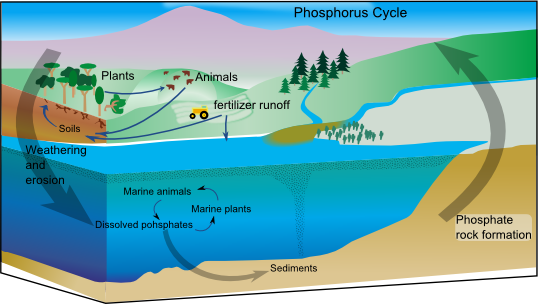
The phosphorus cycle is the biogeochemical pathway detailing the movement of phosphorus, a fundamental element for all life, through the Earth's lithosphere, hydrosphere, and biosphere. Unlike cycles involving carbon or nitrogen, phosphorus's journey is notably absent of significant atmospheric exchange, primarily occurring through geological weathering and biological assimilation. Phosphorus is crucial for DNA, RNA, and energy transfer molecules like ATP, making its availability a key limiting factor for plant growth and ecosystem productivity. Its slow release from rocks and subsequent transport via water bodies dictates its accessibility, leading to distinct terrestrial and aquatic phases. Human activities, particularly the use of fertilizers and detergents, have dramatically accelerated this cycle, causing widespread environmental issues like eutrophication in aquatic systems. Understanding this cycle is paramount for managing agricultural sustainability and protecting water quality worldwide.
🎵 Origins & History
The recognition of phosphorus as an essential element for life emerged gradually. While early alchemists isolated elemental phosphorus, its broader biogeochemical significance wasn't fully grasped for centuries. The concept of cycles in nature gained traction, with scientists highlighting the importance of mineral nutrients for plant growth. By the early 20th century, researchers began piecing together how phosphorus moved through soils, water, and organisms, laying the groundwork for understanding the phosphorus cycle as a distinct biogeochemical process. Early studies often focused on agricultural applications, recognizing phosphorus's role in crop yields, but the full scope of its global circulation and environmental impact took decades to unfold, with significant advancements in the mid-20th century.
⚙️ How It Works
The phosphorus cycle is characterized by its slow geological and biological components, largely bypassing the atmosphere. The primary source of phosphorus is rocks, which weather over geological timescales, releasing phosphate ions (PO₄³⁻) into soils and water. Plants absorb these inorganic phosphates, incorporating them into organic molecules like DNA, RNA, and ATP. When herbivores consume plants, or carnivores consume herbivores, phosphorus is transferred through the food web. Decomposition by bacteria and fungi returns organic phosphorus to the soil and water, where it can be re-assimilated by plants or eventually transported to oceans. In aquatic ecosystems, phosphorus can precipitate into sediments, becoming locked away for millions of years before geological uplift can reintroduce it to the weathering process, thus completing a very long-term cycle.
📊 Key Facts & Numbers
Globally, the phosphorus cycle is remarkably slow, with rock weathering releasing only about 20 million metric tons of phosphorus annually. However, human activities have drastically altered this pace, with anthropogenic inputs now estimated at over 40 million metric tons per year, primarily from fertilizer production and use. Agricultural runoff is a major contributor, with some studies indicating that up to 90% of applied phosphate fertilizers can be lost to waterways. This excess phosphorus leads to eutrophication, where algal blooms consume dissolved oxygen, creating 'dead zones' that can cover thousands of square kilometers, such as those observed in the Gulf of Mexico and the Baltic Sea. The average concentration of dissolved inorganic phosphorus in unpolluted freshwater is typically below 0.01 mg/L, a stark contrast to polluted waters which can exceed 1 mg/L.
👥 Key People & Organizations
Key figures in understanding the phosphorus cycle include Justus von Liebig, whose work on plant nutrition in the 19th century underscored the importance of mineral elements. Hennig Brand's isolation of elemental phosphorus in 1669 was a foundational chemical discovery. Modern understanding has been shaped by countless soil scientists, limnologists, and environmental chemists. Organizations like the USGS and the FAO continuously monitor global phosphorus flows and their environmental impacts. Research institutions worldwide, such as Wageningen University and Cornell University, are at the forefront of developing sustainable phosphorus management strategies.
🌍 Cultural Impact & Influence
The phosphorus cycle's influence extends beyond ecological systems into human culture and economics. Phosphorus is a critical component of fertilizers, making modern agriculture and its ability to feed a growing global population (now over 8 billion people) heavily reliant on its availability. The mining of phosphate rock, primarily in countries like Morocco, China, and Jordan, is a significant global industry. However, the accelerated cycle driven by human activity has led to widespread eutrophication, impacting fisheries, tourism, and drinking water quality, prompting public awareness campaigns and regulatory efforts. The concept of 'peak phosphorus'—the point at which global phosphorus production begins to decline—has also entered public discourse, highlighting resource scarcity concerns.
⚡ Current State & Latest Developments
Current developments in 2024 focus on closing the phosphorus loop through enhanced recycling and recovery. Technologies for recovering phosphorus from wastewater treatment plants, animal manure, and even food waste are gaining traction. Companies like Ostara are commercializing processes to capture phosphorus and convert it into slow-release fertilizers. International collaborations are working to map global phosphorus flows and identify critical resource hotspots, aiming to reduce reliance on virgin phosphate rock and mitigate environmental pollution. The ongoing challenge remains balancing agricultural demand with ecological protection, a tension amplified by climate change impacts on water availability and nutrient runoff.
🤔 Controversies & Debates
The most significant controversy surrounding the phosphorus cycle is the debate over how to manage its accelerated anthropogenic flux. Critics of current agricultural practices argue for stricter regulations on fertilizer use and improved manure management to prevent widespread eutrophication, pointing to the devastating impacts on aquatic ecosystems like the Chesapeake Bay. Conversely, some agricultural sectors express concerns about the economic feasibility and practicality of implementing advanced nutrient management systems, emphasizing the need to maintain crop yields to ensure food security. The finite nature of high-grade phosphate rock reserves also fuels debate about resource depletion and the urgency of developing circular economy approaches for phosphorus.
🔮 Future Outlook & Predictions
The future of the phosphorus cycle will likely be defined by a concerted effort towards circularity. Projections suggest that by 2050, phosphorus recovery from waste streams could meet a substantial portion of global demand, significantly reducing the need for mining. Innovations in precision agriculture, utilizing sensors and data analytics, will enable farmers to apply phosphorus fertilizers more efficiently, minimizing losses. However, the geopolitical implications of phosphate rock distribution and the potential for future scarcity will continue to drive research into alternative nutrient sources and more resilient agricultural systems. The challenge lies in scaling these solutions globally and ensuring equitable access to phosphorus resources while safeguarding environmental health.
💡 Practical Applications
Practical applications of understanding the phosphorus cycle are vast, primarily in agriculture and environmental management. Farmers use knowledge of phosphorus availability to optimize fertilizer application rates, improving crop yields and reducing waste. Environmental scientists and policymakers utilize this understanding to design strategies for mitigating eutrophication, such as establishing buffer zones along waterways and implementing nutrient management plans. Wastewater treatment plants are increasingly incorporating phosphorus removal technologies to protect receiving water bodies. Furthermore, the development of slow-release fertilizers and phosphorus recovery systems represents a direct application of cycle knowledge for resource conservation and pollution reduction.
Key Facts
- Category
- science
- Type
- topic