
Contents
Overview
The genesis of the Seagram Building can be traced to the mid-1950s, a period of post-war economic boom and burgeoning corporate power. Seagram Company, a leading Canadian distiller founded by Samuel Bronfman, sought a prestigious new headquarters in the heart of New York City. Samuel Bronfman's daughter, Phyllis Lambert, took a pivotal role in shaping the project, initially as a consultant and later as the driving force behind its architectural vision. She famously rejected initial designs, insisting on a building that would reflect the company's stature and engage with the urban fabric. Lambert's insistence on hiring Ludwig Mies van der Rohe proved crucial, bringing the renowned modernist architect to the project. Mies van der Rohe, working with Philip Johnson, Ely Jacques Kahn, and Robert Allan Jacobs, conceived a design that would redefine corporate architecture. Construction commenced in 1956, and the building was completed in 1958, immediately becoming a landmark on Park Avenue.
⚙️ Architectural Design & Engineering
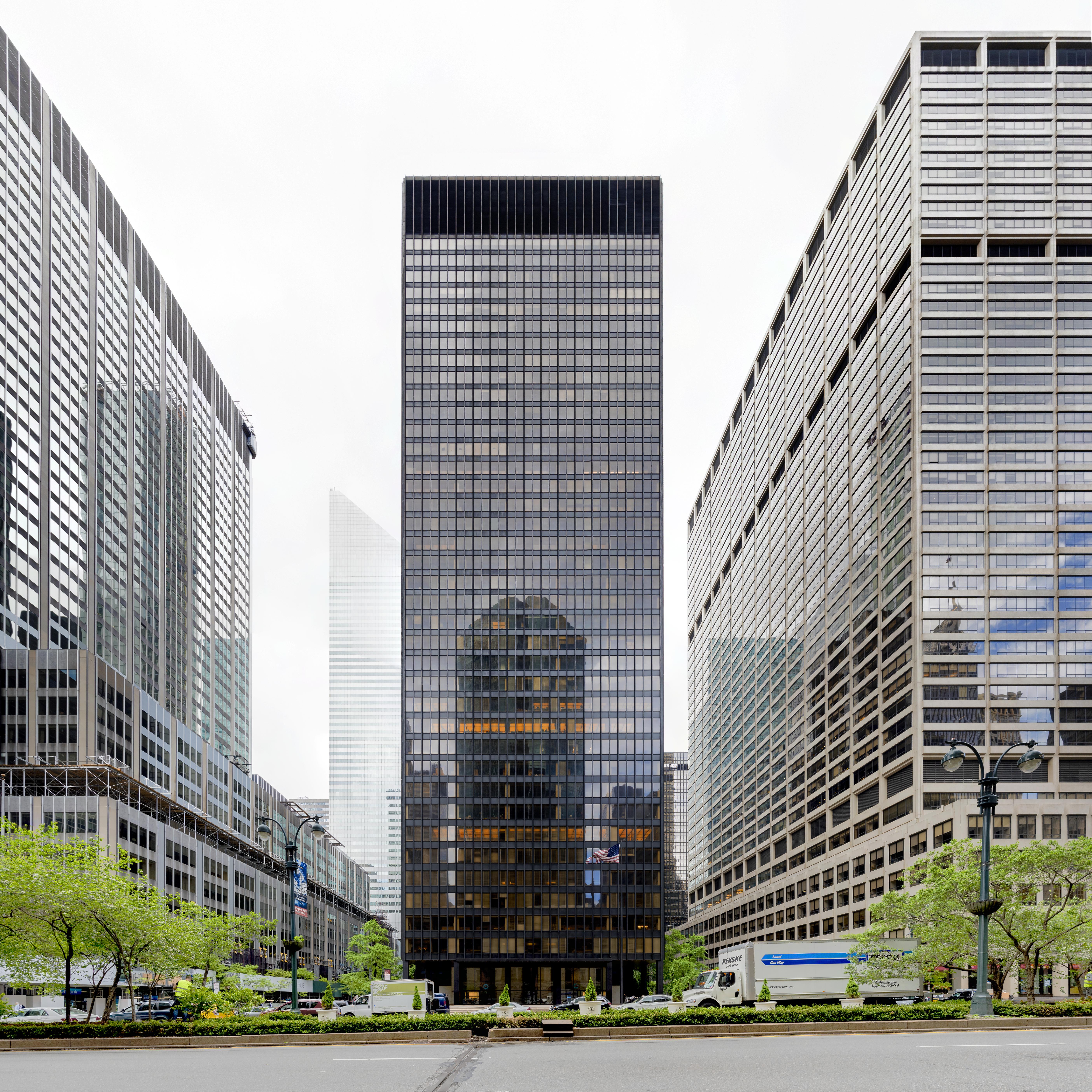
The architectural brilliance of the Seagram Building lies in its sophisticated International Style execution and material choices. Mies van der Rohe's design emphasizes clean lines, geometric purity, and a sense of monumental scale. The exterior is clad in a meticulously crafted bronze and Muntz metal curtain wall, a departure from the glass-dominated facades of many contemporaries. The vertical bronze mullions and horizontal spandrels create a rhythmic, elegant pattern that accentuates the building's height. A defining feature is the expansive, publicly accessible plaza at street level, paved with pink granite and featuring two reflecting pools, which was a radical urban planning concept for its time, offering a respite from the dense urban environment. The elevated lobby, with its travertine floors and dark wood paneling, further enhances the sense of arrival and corporate gravitas. The structural engineering, managed by Severud Associates, ensured the building's stability and iconic silhouette.
📊 Key Facts & Numbers
Standing at 515 feet (157 meters) tall, the Seagram Building comprises 38 stories, offering approximately 400,000 square feet of prime office space. Its construction cost an estimated $35 million, a significant sum for 1958, reflecting the premium materials and design. The building's footprint occupies a full block between 52nd and 53rd streets on Park Avenue, a prestigious address in Midtown Manhattan. The public plaza alone covers 15,000 square feet, a substantial urban amenity. At the time of its completion, it was one of the most expensive office buildings ever constructed. Today, its rental rates remain among the highest in Manhattan, a testament to its enduring desirability and architectural cachet.
👥 Key People & Organizations
The Seagram Building is inextricably linked to several key figures and organizations. Seagram Company, the Canadian spirits giant, was the original client and occupant, its presence defining the building's initial purpose. Phyllis Lambert, daughter of Seagram CEO Samuel Bronfman, was the visionary force behind the design, championing modernist principles and selecting Ludwig Mies van der Rohe as the lead architect. Mies van der Rohe, a titan of modernist architecture, brought his signature aesthetic to the project. Philip Johnson, another influential architect, served as associate architect, contributing significantly to the design, particularly the plaza and lobby. Ely Jacques Kahn and Robert Allan Jacobs also played roles in the architectural team. In the present day, Tishman Speyer Properties is a prominent owner and manager of the building, overseeing its continued operation and leasing.
🌍 Cultural Impact & Influence
The Seagram Building's impact on architectural history and urban design is profound. It established a new benchmark for corporate headquarters, demonstrating that a building could be both a functional office space and a significant work of art. Its bronze facade and public plaza became highly influential, inspiring countless subsequent skyscrapers to incorporate similar materials and urbanistic gestures. The building is widely regarded as a masterpiece of the International Style and a prime example of corporate modern architecture. Its presence has helped define the aesthetic of Park Avenue and continues to be studied in architecture schools worldwide. The building's design philosophy, emphasizing elegance, proportion, and integration with its surroundings, has resonated through generations of architects and urban planners.
⚡ Current State & Latest Developments
As of 2024, the Seagram Building remains a highly sought-after office location in New York City. It continues to house a prestigious roster of tenants, including law firms, financial institutions, and creative agencies. Tishman Speyer has undertaken various renovations and upgrades over the years to maintain its status as a premier Class A office building, ensuring its systems and amenities meet contemporary standards. The building's iconic status means it is frequently featured in films, photography, and art, reinforcing its cultural relevance. Recent leasing activity continues to reflect strong demand for its unique architectural character and prime location.
🤔 Controversies & Debates
The Seagram Building has not been without its controversies, primarily centered around its design and its impact on the urban environment. Phyllis Lambert's initial rejection of preliminary designs and her assertive role in dictating architectural direction sometimes created friction with developers and other stakeholders. The extensive use of bronze, while aesthetically striking, also presented significant maintenance challenges and costs. Furthermore, the building's prominent plaza, while celebrated for its public accessibility, has also been a site of debate regarding its use and the security measures implemented around it. Some critics have also pointed to the building's perceived austerity, a hallmark of Mies van der Rohe's style, as being cold or uninviting compared to more ornate architectural styles.
🔮 Future Outlook & Predictions
The future of the Seagram Building appears secure, given its iconic status and prime location. However, like all historic skyscrapers, it faces the ongoing challenge of adapting to evolving workplace needs and sustainability standards. Future developments may involve further integration of green technologies and energy-efficient systems to meet contemporary environmental goals. The building's architectural integrity will undoubtedly be a primary consideration in any future renovations, balancing preservation with modernization. There is also ongoing discussion about how to best activate and maintain the public plaza in a way that serves the community while respecting the building's heritage. The enduring appeal of its design suggests it will remain a significant architectural landmark for the foreseeable future.
💡 Practical Applications
The Seagram Building's primary application is as a high-prestige office building, serving as a headquarters and workspace for numerous leading corporations. Its design, particularly the public plaza, also serves as an urban amenity, offering a public space for respite and reflection in a dense urban environment. The building's materials and construction techniques have served as a case study for architects and engineers studying modern architectural principles and the application of metals in high-rise construction. Its iconic status also makes it a valuable asset for New York City's tourism and cultural landscape, attracting architects, students, and enthusiasts from around the globe.
Key Facts
- Category
- aesthetics
- Type
- topic