
Contents
- 🎵 Origins & History
- ⚙️ How It Works
- 📊 Key Facts & Numbers
- 👥 Key People & Organizations
- 🌍 Cultural Impact & Influence
- ⚡ Current State & Latest Developments
- 🤔 Controversies & Debates
- 🔮 Future Outlook & Predictions
- 💡 Practical Applications
- 📚 Related Topics & Deeper Reading
- Frequently Asked Questions
- References
- Related Topics
Overview
The roots of the current Sudan conflict are deeply embedded in the nation's post-colonial history, a tapestry woven with military coups, civil wars, and ethnic strife. Since gaining independence from Anglo-Egyptian rule in 1956, Sudan has experienced over two dozen coup attempts and prolonged periods of military dictatorship, most notably under Omar al-Bashir. The 2019 ousting of al-Bashir by a popular uprising, followed by a transitional military-civilian government and then a full military coup in October 2021 led by General al-Burhan, set the stage for the current conflagration. Tensions escalated significantly over the proposed integration of the RSF into the SAF, a key component of a planned transition to civilian rule, highlighting the deep-seated rivalry between the two powerful military factions. The Janjaweed militia, notorious for its role in the Darfur genocide, forms the backbone of the RSF, underscoring the historical grievances and ethnic dimensions fueling the conflict.
⚙️ How It Works
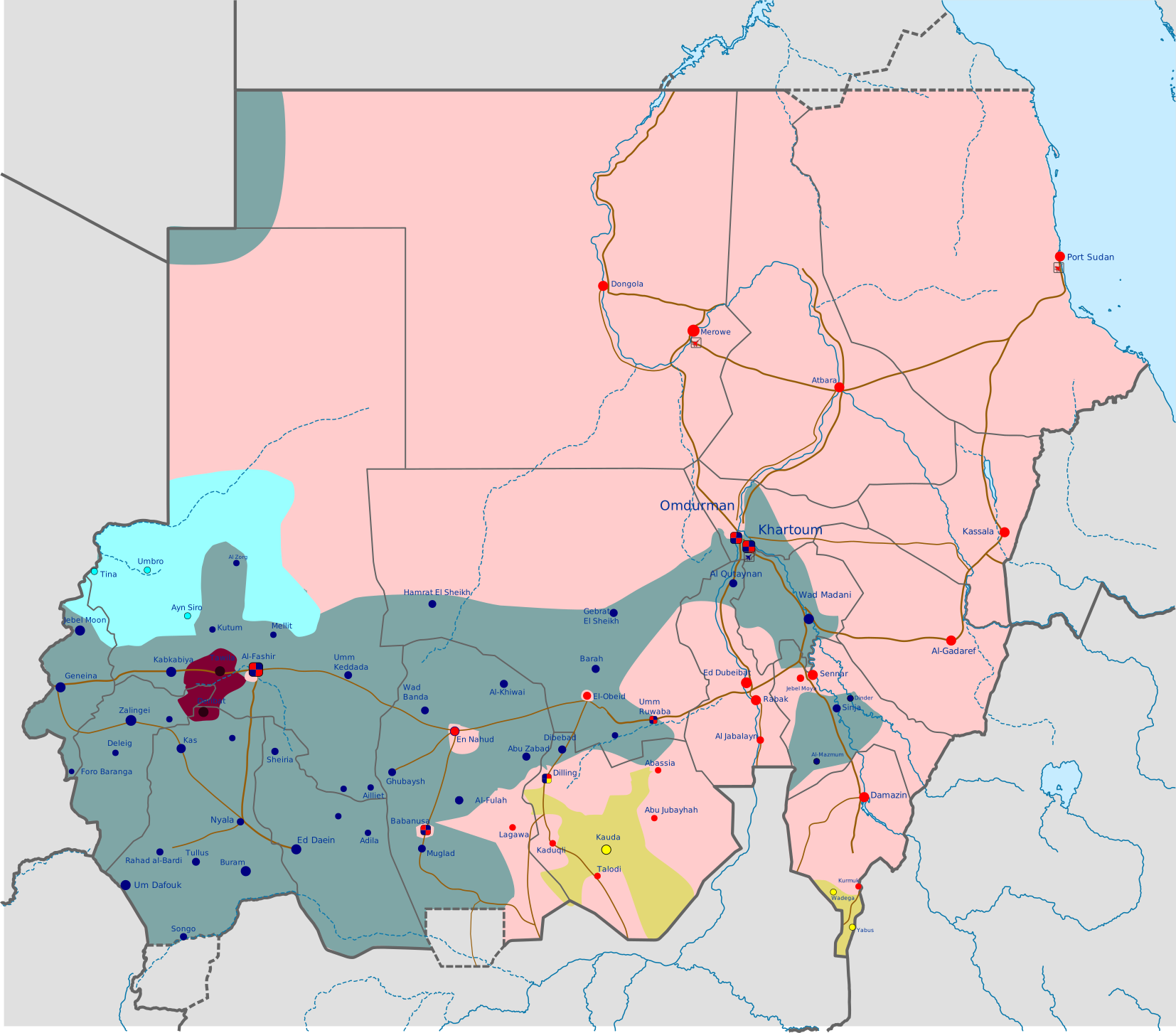
The Sudan conflict operates through a complex interplay of conventional military engagements, asymmetric warfare tactics, and the strategic control of key urban centers and resources. The SAF, nominally the national army, relies on its established command structure and heavier weaponry, including air power, though its effectiveness has been hampered by internal divisions and logistical challenges. The RSF, on the other hand, leverages its extensive network of fighters, often drawn from tribal militias, and its proficiency in urban combat and rapid deployment, particularly in its home base of Darfur. Fighting has been characterized by intense street battles in the capital, Khartoum, and widespread atrocities in regions like Darfur, where the RSF and allied militias have been accused of systematic ethnic cleansing and mass atrocities. Control over vital infrastructure, such as the Khartoum international airport and key bridges, has been a primary objective for both sides, dictating the ebb and flow of the fighting.
📊 Key Facts & Numbers
As of February 5, 2025, the human cost of the Sudan conflict is staggering: over 12 million people have been forcibly displaced, making it the largest displacement crisis globally. Of these, approximately 3.5 million have fled the country as refugees, primarily to neighboring nations like Chad, South Sudan, and Egypt, straining their resources. The United Nations estimates that over 25 million people, more than half of Sudan's population, require humanitarian assistance. Reports indicate that at least 150,000 people have been killed, though exact figures are difficult to ascertain due to the ongoing violence and lack of access. The conflict has decimated Sudan's economy, with an estimated 80% of the workforce unemployed and a significant portion of the population facing acute food insecurity, with projections suggesting millions could starve if aid does not reach them. The destruction of critical infrastructure, including hospitals and water systems, has further exacerbated the humanitarian catastrophe.
👥 Key People & Organizations
The central figures driving the Sudan conflict are General Abdel Fattah al-Burhan, the de facto ruler of Sudan and commander of the SAF, and General Mohamed Hamdan Dagalo, widely known as Hemedti, the commander of the RSF. Al-Burhan, a career military officer, rose to prominence as the chairman of the Transitional Military Council after al-Bashir's ouster and later as the head of the Sovereign Council. Hemedti, a former camel trader, built the RSF into a formidable paramilitary force, amassing significant wealth and political influence, particularly through his control of gold mines in Darfur. Key organizations involved include the SAF and the RSF themselves, along with various smaller rebel factions and allied militias. International actors, including the United States, Saudi Arabia, and the United Arab Emirates, have attempted mediation, while regional bodies like the African Union and the IGAD are involved in diplomatic efforts. The UN and its various agencies, such as UNICEF and the WFP, are central to the humanitarian response.
🌍 Cultural Impact & Influence
The Sudan conflict has had a profound and devastating impact on Sudanese culture and society, exacerbating existing ethnic and regional divides and creating new traumas. The widespread displacement has shattered communities, severing familial ties and disrupting cultural practices. The destruction of cultural heritage sites, particularly in Khartoum, represents an irreparable loss to the nation's historical narrative. Artists, musicians, and writers have used their platforms to document the suffering, call for peace, and preserve the memory of those lost, with many works reflecting themes of loss, resilience, and the yearning for stability. The conflict has also led to a significant brain drain, as educated professionals and skilled workers flee the country, potentially hindering future cultural and intellectual development. The diaspora communities, now swollen with new refugees, play a crucial role in advocating for international intervention and maintaining cultural connections.
⚡ Current State & Latest Developments
As of early 2025, the Sudan conflict remains intensely active, with neither the SAF nor the RSF achieving a decisive victory. Fighting continues to be concentrated in Khartoum, the Darfur region, and along the border with South Sudan. Humanitarian access remains severely restricted, with aid organizations struggling to deliver life-saving assistance to millions in need due to ongoing violence, bureaucratic hurdles, and targeted attacks on aid workers. International mediation efforts, primarily led by Saudi Arabia and the United States, have yielded limited success, with frequent ceasefires being violated. The Sudanese economy is in freefall, with hyperinflation and widespread shortages of basic goods. Reports of mass graves and systematic human rights abuses, including sexual violence and ethnic cleansing, continue to emerge, particularly from Darfur, raising concerns about potential war crimes. The political vacuum persists, with no clear path towards a sustainable peace agreement or a return to civilian rule.
🤔 Controversies & Debates
The Sudan conflict is fraught with controversies, chief among them the allegations of war crimes and crimes against humanity leveled against both the SAF and the RSF. The RSF, in particular, faces widespread accusations of ethnic cleansing and systematic targeting of civilian populations, echoing the atrocities committed by the Janjaweed in Darfur. The SAF has also been implicated in indiscriminate attacks and the use of heavy weaponry in densely populated areas. A significant debate surrounds the role of external actors, with accusations that countries like the UAE and Russia (via the Wagner Group) have provided support to the RSF, while other regional powers are perceived to favor the SAF. The effectiveness and impartiality of international mediation efforts are also debated, with critics arguing that insufficient pressure has been applied to force a genuine ceasefire and a commitment to peace talks. The classification of the conflict and the appropriate international legal responses, including potential ICC investigations, remain contentious issues.
🔮 Future Outlook & Predictions
The future outlook for Sudan is deeply uncertain and largely pessimistic without significant international intervention and a genuine commitment to peace from the warring factions. Experts predict a prolonged period of instability, potentially leading to the further fragmentation of the country. The humanitarian crisis is expected to worsen, with famine becoming a stark reality for millions if aid routes are not secured and the conflict does not cease. The potential for regional spillover, with neighboring countries struggling to cope with the influx of refugees and the risk of cross-border conflict, remains a significant concern. A key question is whether the international community will coalesce to impose meaningful sanctions on those fueling the conflict or provide the robust support needed for a lasting peace settlement. Without a shift in the current trajectory, Sudan risks becoming a failed state, a breeding ground for extremism, and a perpetual humanitarian catastrophe for decades to come.
💡 Practical Applications
While the Sudan conflict itself is not a 'practical application' in the conventional sense, its dynamics and the international response offer insights into the realities of modern warfare and humanitarian intervention. The conflict highlights the devastating effectiveness of paramilitary forces like the RSF in urban combat and their capacity to inflict widespread civilian harm. It underscores the critical importance of secure humanitarian corridors for aid delivery in active war zones, a challenge that international organizations like the WFP constantly grapple with. The conflict also serves as a case study in the complexities of international mediation, demonstrating the difficulties in achieving lasting peace when external actors have competing interests. Furthermore, the widespread use of social media by combatants and civilians alike to document atrocities and rally support offers a stark look at information warfare in the 21st century, influencing global perceptions and calls for action. The lessons learned from Sudan's plight are crucial for shaping future responses to similar crises.
Key Facts
- Year
- 2023-present
- Origin
- Sudan
- Category
- history
- Type
- event
Frequently Asked Questions
What triggered the current Sudan conflict?
The conflict erupted on April 15, 2023, following a breakdown in negotiations between the Sudanese Armed Forces (SAF) and the Rapid Support Forces (RSF) over the integration of the RSF into the national army. This power struggle within the military leadership, established after the 2021 coup, escalated into open warfare, particularly in the capital, Khartoum, and the Darfur region. The SAF, led by General Abdel Fattah al-Burhan, and the RSF, commanded by General Hemedti, have been vying for control of the country, exacerbating decades of underlying political and ethnic tensions.
Who are the main factions involved in the Sudan conflict?
The two primary warring factions are the Sudanese Armed Forces (SAF), led by General Abdel Fattah al-Burhan, and the paramilitary Rapid Support Forces (RSF), commanded by General Mohamed Hamdan Dagalo, known as Hemedti. The RSF is an evolution of the Janjaweed militia, notorious for its role in the Darfur genocide. Various smaller armed groups and allied militias have also become involved, often aligning with one of the two main factions, further complicating the conflict's dynamics and regional impact.
What is the scale of the humanitarian crisis in Sudan?
The Sudan conflict has triggered one of the world's largest displacement crises. As of early 2025, over 12 million people have been forcibly displaced from their homes, with more than 3.5 million fleeing the country as refugees to neighboring nations like Chad, South Sudan, and Egypt. The United Nations estimates that over half of Sudan's population requires humanitarian assistance, facing severe food insecurity, lack of access to clean water, and inadequate healthcare. The destruction of infrastructure and the targeting of aid workers have severely hampered relief efforts.
What is the historical context of the Sudan conflict?
Sudan has a long history of instability since its independence in 1956, marked by multiple civil wars, military coups, and authoritarian rule, most notably under Omar al-Bashir. The current conflict is a culmination of power struggles between the country's dominant military factions, exacerbated by unresolved issues stemming from the Darfur genocide and the marginalization of peripheral regions. The transitional government established after al-Bashir's 2019 ouster and the subsequent 2021 military coup created a volatile environment ripe for the current large-scale conflict.
Are there allegations of war crimes in the Sudan conflict?
Yes, there are widespread and credible allegations of war crimes and crimes against humanity committed by both the SAF and the RSF. The RSF and allied militias have been particularly accused of systematic ethnic cleansing, mass killings, sexual violence, and looting, especially in the Darfur region. The SAF has also faced accusations of indiscriminate attacks, the use of heavy weaponry in civilian areas, and hindering humanitarian aid. International bodies and human rights organizations are documenting these abuses, with calls for accountability and potential ICC investigations.
What is the role of external actors in the Sudan conflict?
Several external actors are implicated in the Sudan conflict, often with competing interests. Some regional powers are accused of providing support to either the SAF or the RSF, complicating mediation efforts. For instance, reports suggest involvement from countries like the UAE and Russia (via the Wagner Group) in supporting the RSF, while other nations may favor the SAF. International mediation efforts are being led by countries such as Saudi Arabia and the United States, with regional organizations like the IGAD also playing a role, though their effectiveness has been limited by the warring factions' intransigence and external influences.
What are the long-term predictions for Sudan's stability?
The long-term outlook for Sudan's stability is bleak without significant international pressure and a genuine commitment to peace from the warring parties. Experts predict a prolonged period of conflict, potential state fragmentation, and a worsening humanitarian crisis, possibly leading to widespread famine. The risk of regional spillover, with neighboring countries bearing the brunt of refugee flows and potential cross-border instability, is high. Without a fundamental shift in the current trajectory, Sudan faces the grim prospect of becoming a failed state, a breeding ground for extremism, and a persistent humanitarian disaster for years to come.