
Contents
Overview
The concept of telomeres emerged from early 20th-century genetic research, with Hermann Joseph Muller first proposing the existence of these 'chromosome ends' in 1938. Muller, an American geneticist who won the Nobel Prize in Physiology or Medicine in 1946 for his work on the effects of radiation on living organisms, observed that chromosome breaks could be rejoined, but natural chromosome ends behaved differently, suggesting a protective mechanism. The term 'telomere' itself was coined by Muller, derived from the Greek 'telos' (end) and 'meros' (part). Decades later, in the 1970s, Soviet biochemist Zhores Medvedev published groundbreaking work suggesting that cellular aging was linked to a limited number of cell divisions, a phenomenon later directly connected to telomere shortening. The discovery of telomerase, the enzyme responsible for maintaining telomere length, was a pivotal moment, largely credited to Elizabeth Blackburn, Carol Greider, and Jack Szostak, who shared the 2009 Nobel Prize in Physiology or Medicine for their work on how chromosomes are protected by telomeres and the enzyme telomerase. Their research, primarily conducted at UC Berkeley and Harvard University, solidified telomeres as central players in aging and cancer biology.
⚙️ How It Works
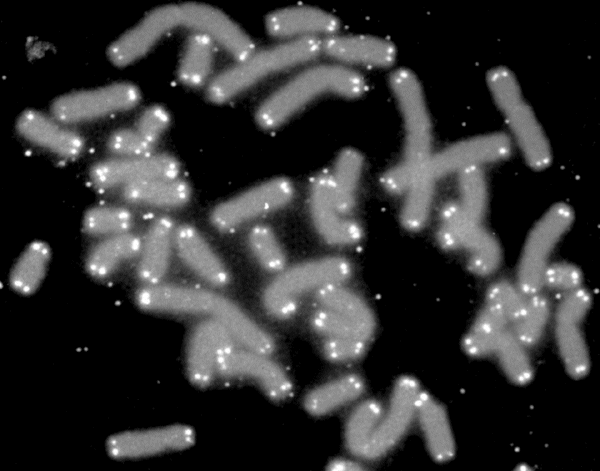
Telomeres function as protective caps on the linear chromosomes of eukaryotes, preventing them from being recognized as DNA damage sites by cellular repair machinery. Each time a cell divides, the DNA replication machinery cannot fully replicate the very end of the lagging strand, leading to a gradual shortening of the telomere with each successive division. This phenomenon, known as the 'end replication problem,' is a fundamental biological constraint. When telomeres reach a critical length, they trigger cellular senescence, a state of irreversible growth arrest, or apoptosis, programmed cell death. This mechanism acts as a tumor suppressor, limiting the proliferative potential of cells and preventing the accumulation of potentially cancerous mutations. The enzyme telomerase, a reverse transcriptase, can counteract this shortening by adding repetitive DNA sequences back to the telomeres, thereby maintaining their length and allowing cells to divide more times. This activity is crucial for stem cells and germ cells, but is typically suppressed in most somatic cells.
📊 Key Facts & Numbers
Human telomeres are composed of thousands of repeats of the sequence TTAGGG on one strand and its complement on the other. The average human telomere length at birth is approximately 10,000 base pairs, but this length decreases by about 25-50 base pairs per year of life. By age 65, telomere length can be reduced by as much as 3,000-6,000 base pairs. Studies have indicated that individuals with shorter telomeres are at a 2-3 times higher risk of developing age-related diseases such as cardiovascular disease and certain cancers. For instance, a meta-analysis published in Nature Genetics in 2014 involving over 30,000 participants found significant associations between shorter telomere length and increased mortality risk. In contrast, cancer cells often reactivate telomerase, allowing them to maintain telomere length and achieve replicative immortality, with up to 85-90% of human cancers exhibiting telomerase activity.
👥 Key People & Organizations
The foundational work on telomeres and telomerase was spearheaded by Elizabeth Blackburn, Carol Greider, and Jack Szostak, who were jointly awarded the 2009 Nobel Prize in Physiology or Medicine. Blackburn, working at UC Berkeley, and Greider, at Johns Hopkins University, discovered telomerase in 1985. Szostak, at Harvard University, demonstrated the essential role of telomeres in chromosome stability using yeast models. Other key figures include Hermann Muller, who first proposed the existence of telomeres in 1938, and Zhores Medvedev, who theorized about the limited number of cell divisions in the 1970s. Organizations like the Gerontology Society of America and the National Institute on Aging fund extensive research into telomere biology and its implications for aging and disease. Companies such as Telomir Pharmaceuticals are actively developing therapies targeting telomere length.
🌍 Cultural Impact & Influence
Telomere biology has permeated popular culture, often framed as the 'biological clock' or the 'secret to eternal youth.' The concept has fueled interest in anti-aging interventions and longevity research, appearing in numerous books, documentaries, and health blogs. While the scientific community emphasizes the complexity of aging, the public fascination with telomeres has led to the proliferation of 'telomere testing' services, promising insights into one's biological age, though the clinical utility and interpretation of these tests remain subjects of debate. This widespread interest has also influenced the narrative around cancer, highlighting the role of telomere maintenance in tumor progression and the potential for telomere-targeting therapies. The idea that telomere length can be influenced by lifestyle factors, such as diet and exercise, has further amplified its cultural resonance, making it a tangible, albeit simplified, representation of the aging process.
⚡ Current State & Latest Developments
Current research in telomere biology is rapidly advancing, focusing on therapeutic interventions and diagnostic applications. Telomir Pharmaceuticals recently announced FDA clearance of an Investigational New Drug (IND) application for Telomir-Zn, a drug aimed at targeting telomere length in triple-negative breast cancer, marking a significant step towards clinical application. Studies are also exploring the role of telomere length in various diseases, including HIV/AIDS, where some treatments have shown potential to reduce biological aging by several years. The development of senolytic drugs, which selectively eliminate senescent cells, is another active area, with telomere shortening being a key trigger for senescence. Furthermore, advancements in CRISPR-Cas9 gene editing technology are opening new avenues for potentially manipulating telomerase activity or telomere length in a targeted manner, though ethical considerations are paramount. The XPRIZE Healthspan competition is also spurring innovation in areas related to biological age, where telomere dynamics play a role.
🤔 Controversies & Debates
A significant controversy surrounds the interpretation and clinical application of telomere length measurements. While shorter telomeres are correlated with increased risk of certain diseases and mortality, they are not a definitive predictor of individual lifespan or health outcomes. Critics argue that 'telomere testing' services often overstate their predictive power and lack robust clinical validation. Another debate centers on the therapeutic manipulation of telomerase. While reactivating telomerase could potentially reverse aging and treat degenerative diseases, it also carries the risk of promoting cancer by enabling uncontrolled cell proliferation. Conversely, inhibiting telomerase is a strategy for cancer treatment, but its long-term effects on aging and tissue regeneration are not fully understood. The ethical implications of interventions that could significantly extend human lifespan or alter the aging process also remain a subject of intense discussion.
🔮 Future Outlook & Predictions
The future of telomere biology promises exciting therapeutic and diagnostic breakthroughs. Researchers are actively developing drugs that can safely modulate telomerase activity, aiming to either inhibit it in cancer cells or activate it to combat age-related diseases and promote tissue regeneration. The development of personalized medicine approaches, where telomere length and telomerase activity are used as biomarkers for disease risk and treatment response, is also anticipated. Furthermore, advancements in understanding the interplay between telomeres, epigenetics, and environmental factors could lead to novel strategies for promoting healthy aging. The potential for telomere-based ther
Key Facts
- Category
- science
- Type
- topic