
Contents
Overview
The quest to quantify heat began in earnest during the 17th and 18th centuries, driven by burgeoning scientific curiosity and the need for reproducible measurements. Early pioneers like Daniel Gabriel Fahrenheit and Anders Celsius developed scales based on observable phenomena, primarily the freezing and boiling points of water, though their initial definitions sometimes differed from modern usage. The concept of absolute zero, the theoretical point at which all molecular motion ceases, was a critical development, leading to the absolute temperature scale later named after Lord Kelvin in the mid-19th century. Other historical scales, such as the Isaac Newton scale and the Joseph Nicéphore Niépce scale (though Niépce is more known for photography, his father Claude Niépce proposed a scale), also contributed to the evolving understanding of thermometry, each offering unique reference points and divisions.
⚙️ How It Works
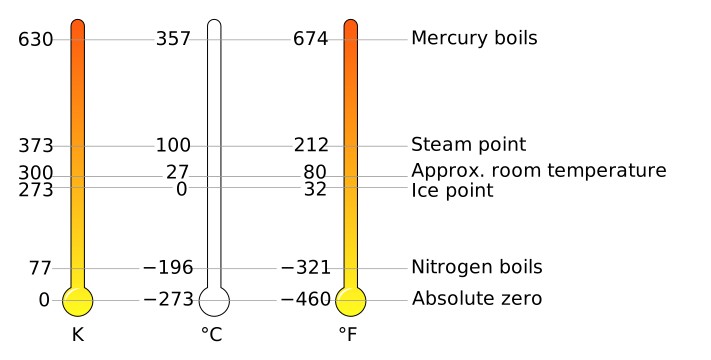
Temperature scales fundamentally operate by assigning numerical values to the degree of hotness or coldness, based on a defined zero point and a unit of measurement. Empirical scales, like Celsius and Fahrenheit, typically anchor their definitions to two easily reproducible physical states: the freezing point and the boiling point of water at standard atmospheric pressure. For example, the Celsius scale sets 0°C for freezing and 100°C for boiling. The Fahrenheit scale uses 32°F for freezing and 212°F for boiling. Absolute scales, such as Kelvin, are rooted in thermodynamics and define their zero point as absolute zero, the lowest possible temperature. The Kelvin scale uses the same degree size as Celsius but starts at absolute zero (0 K), making it the standard for scientific calculations where negative temperatures are not physically meaningful. The conversion between these scales involves linear equations that account for their different zero points and interval sizes, allowing for seamless translation of temperature readings across different systems.
📊 Key Facts & Numbers
The Celsius scale is used by approximately 90% of the world's population, with only the United States, Cayman Islands, Liberia, and Myanmar officially using Fahrenheit for most everyday purposes. The Kelvin scale is the SI base unit for thermodynamic temperature, with 0 K equivalent to -273.15°C or -459.67°F. Water freezes at 273.15 K and boils at 373.15 K. The Rankine scale, an absolute scale based on Fahrenheit, has 0°R at absolute zero, with a boiling point of water at 671.67°R. The Delisle scale, developed in the early 18th century, had 2700° for boiling water and 0° for freezing, reflecting a different historical approach to thermometry. The Réaumur scale, once popular in parts of Europe, set freezing at 0°Ré and boiling at 80°Ré.
👥 Key People & Organizations
Several key figures shaped the landscape of temperature measurement. Daniel Gabriel Fahrenheit (1686–1736), a Dutch-German physicist, is credited with inventing the first widely used mercury thermometer and establishing his eponymous scale. Anders Celsius (1701–1744), a Swedish astronomer, proposed his centigrade scale in 1742, which, after inversion, became the modern Celsius scale. Lord Kelvin (1824–1907), a British mathematical physicist, formulated the concept of absolute temperature and the Kelvin scale, a cornerstone of thermodynamics. Organizations like the International Bureau of Weights and Measures (BIPM) play a crucial role in maintaining the international standards for temperature measurement through the International System of Units (SI). The National Institute of Standards and Technology (NIST) in the United States performs similar standardization functions domestically.
🌍 Cultural Impact & Influence
Temperature scales are fundamental to countless aspects of modern life and culture. Weather forecasts, cooking temperatures, medical diagnostics, and industrial processes all rely on standardized temperature readings. The widespread adoption of Celsius globally has facilitated international scientific collaboration and trade, while the persistence of Fahrenheit in the United States often leads to confusion in international contexts. The very concept of "cold" and "hot" is culturally interpreted, but the scales provide an objective, quantifiable measure. For instance, the chilling effect of a -10°C winter day is universally understood as significantly colder than a 20°C spring afternoon, regardless of the specific scale used, though the numerical values differ. The development of these scales also reflects a broader cultural embrace of scientific rationalism and the desire to impose order on the natural world.
⚡ Current State & Latest Developments
The current state of temperature measurement is largely dominated by the Celsius and Kelvin scales in scientific and international contexts, and Fahrenheit in the United States. However, the ongoing drive for precision in scientific research, particularly in fields like cryogenics and astrophysics, necessitates increasingly sophisticated thermometry and the accurate calibration of these scales. The International Committee for Weights and Measures regularly reviews and refines the definitions of SI units, including temperature, ensuring their stability and accuracy. Developments in digital sensors and data logging have made temperature monitoring more accessible and ubiquitous than ever before, from smart home thermostats to industrial IoT devices. The ongoing exploration of extreme temperatures, such as those found in stellar cores or near absolute zero, continues to push the boundaries of our measurement capabilities.
🤔 Controversies & Debates
One persistent point of contention, particularly in the United States, is the ongoing debate over the adoption of the Celsius scale for everyday use. Proponents argue that a global standard would simplify international communication, trade, and education, reducing confusion and errors. Opponents, however, often cite the cost and complexity of transitioning infrastructure and public education, as well as a general resistance to change. Another area of debate, more within the scientific community, concerns the ultimate precision and stability of temperature standards. While the Kelvin scale is defined by fundamental physical constants, achieving and maintaining measurements at extremely low or high temperatures with absolute certainty remains a technical challenge, leading to ongoing research into more robust calibration methods and potential refinements to the SI definition itself.
🔮 Future Outlook & Predictions
The future of temperature scales will likely involve greater integration with digital technologies and a continued push for higher precision. As fields like quantum computing and advanced materials science demand ever more accurate temperature control and measurement, the limitations of current scales and instrumentation may become more apparent. There's a potential for the development of new, more fundamental scales based on quantum phenomena or other universal physical constants, moving beyond the reliance on water's phase transitions. Furthermore, as global communication becomes more seamless, the pressure for universal adoption of the Celsius scale, or at least greater interoperability, may intensify. The ongoing exploration of exoplanets and the universe's thermal extremes will also continue to drive innovation in how we define and measure temperature across vast cosmic distances and conditions.
💡 Practical Applications
Temperature scales are indispensable in a vast array of practical applications. In meteorology, they are used to forecast weat
Key Facts
- Category
- science
- Type
- topic