
Contents
Overview
The trapezius muscle's anatomical description dates back to classical antiquity, with early physicians like Galen detailing its structure and function. Its name, derived from the Greek word 'trapezion' meaning 'uneven quadrilateral' or 'little table,' aptly describes its shape. While its basic form was understood for centuries, detailed functional analysis and its role in complex movements like throwing or lifting were refined through the work of anatomists and physiologists in the 19th and 20th centuries. Early anatomical texts, such as those by Henry Gray in his seminal work 'Gray's Anatomy' (first published in 1858), provided foundational descriptions that remain largely accurate today, though modern biomechanics has added layers of understanding regarding its dynamic coordination with other muscles like the rhomboids and serratus anterior.
⚙️ How It Works
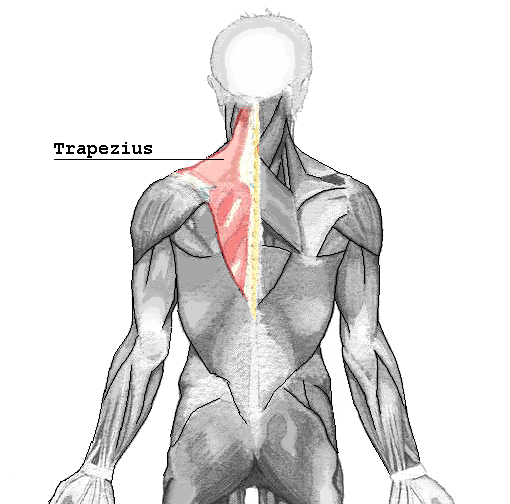
The trapezius operates through three distinct functional regions, each innervated by the spinal accessory nerve (cranial nerve XI) and branches of the cervical nerves. The upper (descending) fibers originate from the occipital bone and nuchal ligament, inserting onto the lateral third of the clavicle; they elevate the scapula and assist in extending the neck. The middle (transverse) fibers run from the spinous processes of the thoracic vertebrae to the acromion; they retract the scapula, pulling the shoulder blades together. The lower (ascending) fibers originate from the spinous processes of the lower thoracic vertebrae and insert onto the medial end of the spine of the scapula, depressing the scapula and rotating it medially. This coordinated action is essential for overhead reaching, posture, and stabilizing the shoulder girdle during various activities, from weightlifting to playing musical instruments.
📊 Key Facts & Numbers
The trapezius muscle covers a significant surface area, extending from the base of the skull down to approximately the T12 vertebra, and laterally to the spine of the scapula. Its total mass can constitute a substantial portion of the upper body musculature. In terms of muscle fiber composition, the upper fibers are predominantly slow-twitch (Type I), suited for sustained postural control, while the lower fibers exhibit a higher proportion of fast-twitch (Type II) fibers, enabling rapid, powerful movements like scapular depression. Studies on muscle activation patterns, often using electromyography (EMG), reveal that specific exercises like pull-ups and deadlifts can elicit up to 70-80% of maximal voluntary contraction in the middle and lower trapezius fibers, highlighting their capacity for strength development.
👥 Key People & Organizations
While no single individual 'discovered' the trapezius, anatomists like Galen provided early detailed descriptions. In modern times, researchers in biomechanics and sports science, such as those at institutions like the University of California, Los Angeles (UCLA) and the University of Pittsburgh Medical Center (UPMC), have extensively studied its function and rehabilitation. Organizations like the National Strength and Conditioning Association (NSCA) disseminate knowledge on training and strengthening the trapezius for athletic performance. In the realm of aesthetics, figures like Arnold Schwarzenegger popularized the development of the upper trapezius for bodybuilding, making it a recognizable feature in the physique of many bodybuilding competitors.
🌍 Cultural Impact & Influence
The trapezius muscle holds significant cultural weight, particularly in the context of physical appearance and athletic prowess. In Western culture, well-developed upper trapezius muscles are often associated with strength and power, especially in sports like American football and wrestling. Conversely, chronic tension and 'knots' in the trapezius are widely recognized symbols of stress and poor posture, frequently depicted in popular media and discussed in everyday conversations about well-being. The muscle's aesthetic appeal in bodybuilding, often referred to as 'traps,' has been a key feature in the visual language of fitness for decades, influencing training regimens and aesthetic ideals. Its role in supporting the head also links it to concepts of burden and responsibility, as in the idiom 'carrying the weight of the world on one's shoulders.'
⚡ Current State & Latest Developments
Current research continues to refine our understanding of trapezius muscle function, particularly in relation to chronic pain syndromes and rehabilitation. Studies are exploring the neural control and motor learning strategies for improving trapezius activation in individuals with scapular dyskinesis. Advances in wearable technology are enabling more sophisticated real-time monitoring of trapezius muscle activity during daily tasks, offering new insights into the impact of sedentary lifestyles and ergonomic interventions. The ongoing debate about optimal training protocols for hypertrophy versus functional strength in the trapezius also remains a dynamic area of interest for fitness professionals.
🤔 Controversies & Debates
A persistent debate surrounds the 'ideal' trapezius development, particularly the upper fibers. While bodybuilders often pursue significant hypertrophy, some physical therapists and biomechanics experts caution against excessive development of the upper trapezius, arguing it can lead to poor scapular mechanics, forward head posture, and increased risk of neck pain and shoulder impingement. They advocate for balanced development, emphasizing the middle and lower trapezius for proper scapular retraction and stability. This contrasts with the aesthetic goals of some athletes and the common perception that larger 'traps' equate to greater strength. The role of the trapezius in chronic pain conditions, such as fibromyalgia and myofascial pain syndrome, also remains a subject of ongoing research and clinical discussion.
🔮 Future Outlook & Predictions
The future of understanding and interacting with the trapezius muscle points towards more personalized and technology-driven approaches. Advanced biofeedback devices and virtual reality training are likely to play a larger role in rehabilitation and performance enhancement, offering immersive ways to correct faulty movement patterns. Predictive modeling, utilizing AI and large datasets from wearable sensors, may soon forecast an individual's susceptibility to trapezius strain based on their daily activities and biomechanical profile. Furthermore, research into neuromodulation techniques for pain management could offer novel non-pharmacological treatments for chronic trapezius tension.
💡 Practical Applications
The trapezius muscle is central to numerous practical applications. In physical therapy, exercises targeting specific trapezius fibers are fundamental for rehabilitating shoulder and neck injuries, correcting postural deviations, and improving scapular stability after rotator cuff injuries. For athletes, understanding trapezius function is critical for optimizing performance in sports requiring overhead movements, such as swimming and tennis, or those involving powerful pulling actions like rowing. In ergonomics, awareness of trapezius strain is vital for designing effective workstations and promoting healthy sitting habits to mitigate the effects of prolonged computer use.
Key Facts
- Category
- science
- Type
- topic