
Contents
Overview
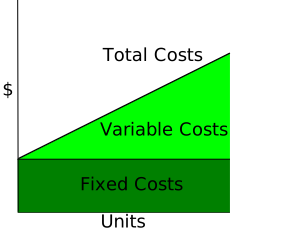
Variable costs are expenses that fluctuate directly with the volume of production or sales. Unlike fixed costs, which remain constant regardless of output, variable costs increase as more goods or services are produced and decrease when production slows. They are the sum of marginal costs across all units and, alongside fixed costs, form the total cost structure of a business. Examples range from direct materials like raw components to direct labor involved in manufacturing, and even sales commissions tied to revenue. Understanding variable costs is critical for pricing strategies, break-even analysis, and assessing the profitability of scaling operations, forming a fundamental pillar of managerial accounting and business strategy. Their dynamic nature makes them a key focus for cost control and efficiency improvements.
🎵 Origins & History
The concept of distinguishing between fixed and variable costs traces back to early economic thought, solidifying in the late 19th and early 20th centuries. Early economists recognized that some costs, like raw materials for a factory, scaled directly with output, while others, like rent for the factory building, did not. This distinction became crucial for businesses aiming to understand their true profitability and make informed pricing decisions. The distinction between variable costs, fixed costs, and mixed costs (also known as semi-variable costs) was further refined over time.
⚙️ How It Works
Variable costs are fundamentally tied to the volume of output. For every additional unit a business produces or sells, a corresponding increase in variable cost is incurred. This relationship can be linear, where each unit adds the exact same cost (e.g., the cost of one specific screw in an assembly), or it can be more complex, exhibiting step-variable behavior where costs increase in chunks as production levels cross certain thresholds. The direct materials used in manufacturing are a classic example: if a widget requires 2 kg of plastic, producing 100 widgets requires 200 kg. Similarly, direct labor costs often scale with production, as more workers or more hours are needed to produce more units. Even some overheads, like sales commissions paid as a percentage of revenue, are variable. The core principle is that if production stops, these costs theoretically drop to zero, unlike fixed costs which persist.
📊 Key Facts & Numbers
For service industries, variable costs might include the direct labor hours spent on a client project.
👥 Key People & Organizations
While variable costs are a fundamental economic concept rather than a specific invention, several economists and accountants have been instrumental in their study and application. The gig economy is characterized by agile businesses managing variable expenses.
🌍 Cultural Impact & Influence
The concept of variable costs has profoundly shaped how businesses operate and how economies are structured. It underpins the logic of economies of scale, where increasing production volume can lower the per-unit variable cost through bulk purchasing and optimized processes. This understanding influences pricing strategies, enabling companies to set prices that cover variable costs and contribute to fixed costs and profit. The ability to scale operations up or down based on demand, directly managing variable expenses, is a hallmark of agile businesses in the gig economy and beyond.
⚡ Current State & Latest Developments
Companies are increasingly leveraging artificial intelligence and big data analytics to gain real-time visibility into their variable expenses, from raw material price fluctuations to labor availability. Manufacturers are using AI-powered forecasting tools to predict material needs. Logistics firms are optimizing routes to reduce fuel consumption, a significant variable cost. The push towards sustainability impacts variable costs, as businesses explore eco-friendly materials or energy-efficient production methods, which can sometimes initially increase variable costs but offer long-term savings or market advantages.
🤔 Controversies & Debates
A persistent debate revolves around the classification of certain costs. Mixed costs, also known as semi-variable costs, have a fixed and a variable component. Determining the precise split between fixed and variable elements can be challenging and often requires statistical methods like regression analysis. Overly simplistic classifications of costs can lead to flawed decision-making, particularly in break-even analysis or when evaluating the profitability of new product lines. Automation can blur the lines between fixed and variable costs, where initial fixed costs for machinery might reduce long-term variable labor costs, blurring traditional cost structures.
🔮 Future Outlook & Predictions
The future of variable cost management will likely be dominated by hyper-personalization and advanced automation. As businesses move towards producing highly customized goods and services, the traditional model of uniform variable costs per unit will become less applicable. Instead, costs will need to be tracked at a more granular level, potentially per customer or per specific product configuration. The increasing adoption of robotics and 3D printing in manufacturing suggests a future where production can be scaled more flexibly, potentially lowering the marginal cost of customization. Furthermore, the rise of the subscription economy means many businesses will focus on predictable, recurring revenue streams, where managing the variable costs associated with customer acquisition and service delivery becomes paramount. Experts predict that predictive analytics will play an even larger role, allowing companies to anticipate cost fluctuations before they occur.
💡 Practical Applications
Variable costs are central to numerous practical business applications. In pricing strategy, understanding variable costs allows businesses to set minimum prices that ensure each sale contributes to covering fixed expenses and generating profit. For break-even analysis, the formula (Fixed Costs / (Sales Price Per Unit - Variable Cost Per Unit)) is fundamental, showing the sales volume needed to cover all costs. Budgeting and forecasting rely heavily on projecting future variable costs based on anticipated sales volumes. Managers use variable cost data to make 'make or buy' decisions, comparing the internal variable costs of production against the external purchase price. In performance evaluation, tracking deviations in variable costs from budgeted amounts helps identify operational inefficiencies or external price shocks.
Key Facts
- Category
- economics
- Type
- topic